Acts 15 is often treated as the final word on Torah and Gentile believers. Many are taught that the Jerusalem Council reduced God’s instructions to just a handful of rules for non-Jewish Christians—and that everything else was set aside.
But that is not what the text actually says. When read carefully, Acts 15 reveals something very different: a starting point for new believers coming out of paganism, not the totality of Christian obedience.
Understanding Acts 15 requires understanding who these believers were and where they were coming from.
The Gentiles entering the faith in Acts were not former churchgoers with a basic moral framework shaped by Scripture.
They were former pagans—idol worshipers immersed in temple prostitution, ritual meals, blood consumption, and occult practices. This was absolutely abhorrent to the Jewish believers, yet somehow they were to bring these two groups of people together.
“So, what am I saying? That food sacrificed to idols has any significance in itself? or that an idol has significance in itself? No, what I am saying is that the things which pagans sacrifice, they sacrifice not to God but to demons; and I don’t want you to become sharers of the demons! You can’t drink both a cup of the Lord and a cup of demons, you can’t partake in both a meal of the Lord and a meal of demons.” —1 Corinthians 10:19–21
“Therefore, remember your former state: you Gentiles by birth — called the Uncircumcised by those who, merely because of an operation on their flesh, are called the Circumcised — at that time had no Messiah. You were estranged from the national life of Isra’el. You were foreigners to the covenants embodying God’s promise. You were in this world without hope and without God.” —Ephesians 2:11–12
Their entire worldview, ethics, and worship habits needed transformation. Expecting immediate full Torah observance would have been overwhelming and pastorally irresponsible.
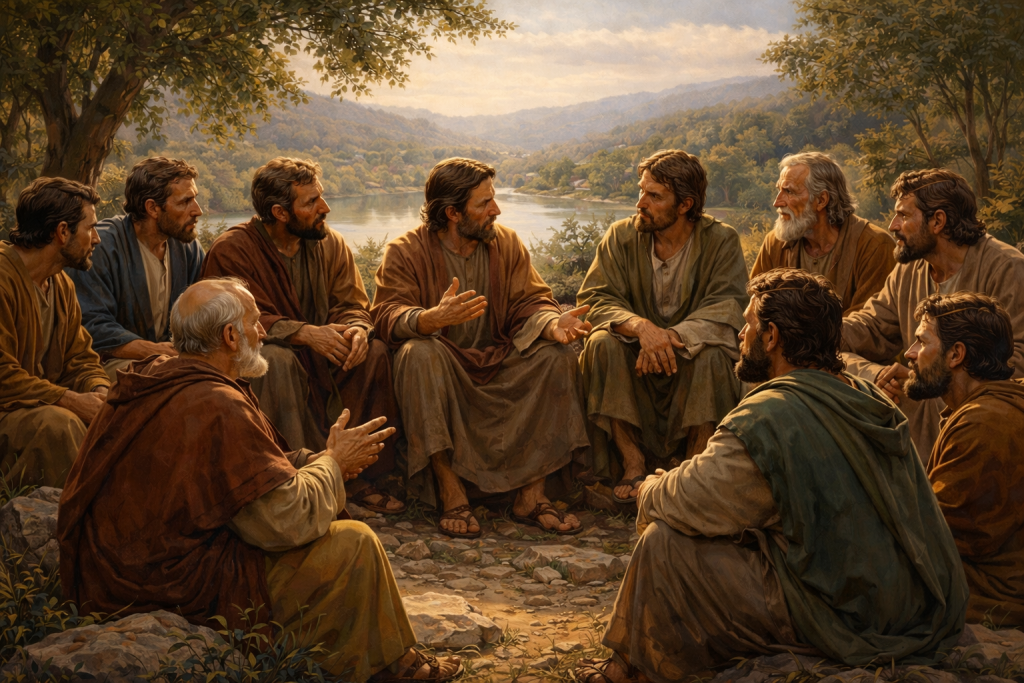
This is the context for the Jerusalem Council.
The presenting issue in Acts 15 was not obedience—it was salvation. Some believers were teaching that Gentiles must be circumcised and keep the Law in order to be saved
But some men came down from Y’hudah to Antioch and began teaching the brothers, “You can’t be saved unless you undergo b’rit-milah in the manner prescribed by Moshe….But some of those who had come to trust were from the party of the P’rushim; and they stood up and said, “It is necessary to circumcise them and direct them to observe the Torah of Moshe.” —Acts 15:1, 5
The apostles firmly rejected this claim. Salvation, they affirmed, comes through the grace of the Lord Jesus—not through conversion to Judaism or works of the Law.
“No, it is through the love and kindness of the Lord Yeshua that we trust and are delivered — and it’s the same with them.” —Acts 15:11
Once that issue was settled, the council addressed a second concern: fellowship and discipleship.
Jacob (James), speaking with pastoral wisdom, proposed four immediate prohibitions for Gentile believers: abstaining from idolatry, sexual immorality, things strangled, and blood.
“Therefore, my opinion is that we should not put obstacles in the way of the Goyim who are turning to God. Instead, we should write them a letter telling them to abstain from things polluted by idols, from fornication, from what is strangled and from blood.” —Acts 15:19–20
These were not random rules. Every one of them directly addressed core pagan worship practices and severe Torah violations that would have made fellowship with Jewish believers impossible .
This was not a reduced version of Torah—it was a triage plan.
These instructions functioned as a spiritual “kindergarten,” removing the most urgent and destructive practices so that Gentile believers could begin learning a holy way of life. The apostles were not defining the end of obedience, but establishing a foundation for growth.
Jacob makes this explicit in the very next verse—one that is often overlooked:
“For from the earliest times, Moshe has had in every city those who proclaim him, with his words being read in the synagogues every Shabbat.” —Acts 15:21
This statement only makes sense if the expectation was ongoing learning. Gentile believers would hear Torah taught regularly as they gathered, learn gradually, and grow in obedience over time.
In other words, Acts 15 assumes a process.
Scripture consistently supports this pattern. God has always taught His people progressively, meeting them where they are and leading them forward (Deuteronomy 6:6–7; Proverbs 4:18). Yeshua (Jesus) Himself described discipleship as a lifelong journey of learning and obedience, not instant mastery.
Therefore, go and make people from all nations into talmidim, immersing them into the reality of the Father, the Son and the Ruach HaKodesh, and teaching them to obey everything that I have commanded you. And remember! I will be with you always, yes, even until the end of the age. —Matthew 28:19–20
The apostles taught believers to grow from spiritual infancy toward maturity (1 Corinthians 3:1–2; Hebrews 5:12–14).
Acts 15 fits squarely within that framework.
If the four instructions were meant to permanently replace Torah, then Jacob’s reference to weekly Torah teaching would be meaningless. If Gentiles were never meant to learn God’s instructions beyond those four points, there would be no reason to mention Moses at all. The council was not abolishing Torah—it was prioritizing discipleship.
This also explains why the rest of the New Testament continues to teach obedience, holiness, and moral transformation rooted in God’s commandments.
“For what the Torah could not do by itself, because it lacked the power to make the old nature cooperate, God did by sending his own Son as a human being with a nature like our own sinful one [but without sin]. God did this in order to deal with sin, and in so doing he executed the punishment against sin in human nature, so that the just requirement of the Torah might be fulfilled in us who do not run our lives according to what our old nature wants but according to what the Spirit wants.” —Romans 8:3–4
“The way we can be sure we know him is if we are obeying his commands. Anyone who says, “I know him,” but isn’t obeying his commands is a liar — the truth is not in him. But if someone keeps doing what he says, then truly love for God has been brought to its goal in him. This is how we are sure that we are united with him. A person who claims to be continuing in union with him ought to conduct his life the way he did.” —1 John 2:3–6
Prayerful Reflections
The apostles never treat Acts 15 as the ceiling of Christian obedience. They treat it as the doorway into a transformed life.
Acts 15 does not say, “This is all God requires.” It says,“This is where we will begin.”
As followers of Messiah, we read Acts 15 as a model of grace-filled wisdom. New believers are not crushed under immediate expectations, nor are they left without direction. They are welcomed, protected, taught, and given time to grow.
Grace brings people in.
Torah teaches them how to live once they belong.
Walking in Torah means honoring the process—patient discipleship rooted in truth, mercy, and confidence that God’s ways are good. The Jerusalem Council did not lower the standard of holiness. It opened the door for former pagans to begin walking toward it, one faithful step at a time.