A Biblical Understanding for New Testament & Whole Bible Believers
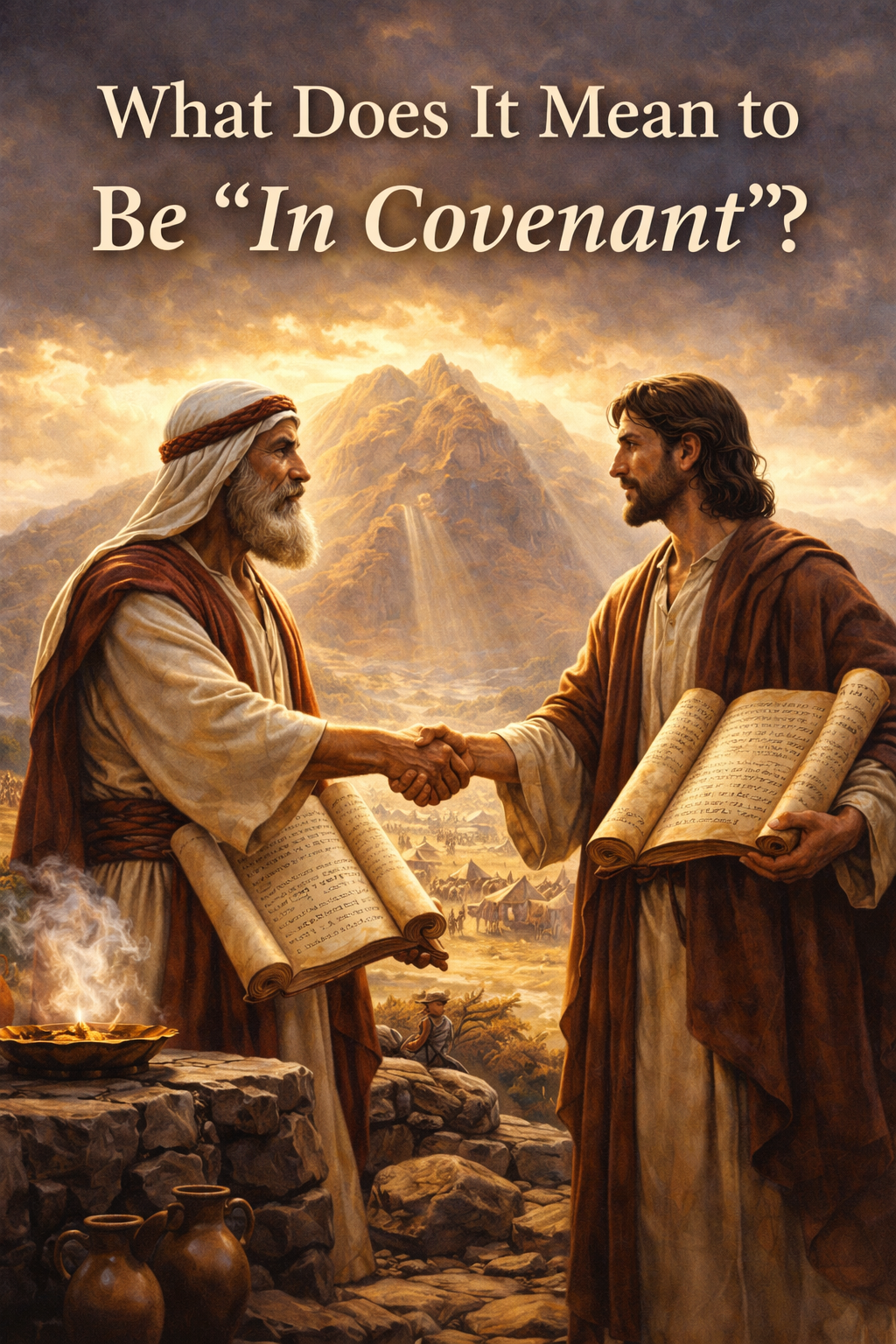
In today’s Christian culture, the word covenant is often not well understood, or is used lightly. We speak of covenant marriage, covenant friendships, even covenant churches. But biblically speaking, covenant is not a sentimental agreement. It is not a handshake. A covenant is a binding, sacred relationship initiated by God Himself.
To understand what it means to be “in covenant,” we must return to Scripture and as always allow the Bible to define its own terms.
What Is a Covenant?
The Hebrew word for covenant is “berit” (בְּרִית). It describes a solemn, binding agreement between two parties, often sealed with blood, sacrifice, and an oath.
In the ancient Near Eastern world, covenants were life-binding commitments.
To “cut a covenant” (Genesis 15:18) literally involved sacrifice, symbolizing that breaking the covenant carried serious consequences.
The seriousness of making a covenant was displayed in the shedding of the blood. It was saying “If I break my part of the deal, may what happened to this animal, be done to me!”
We first see covenant language clearly used with Noah:
“But I will establish my covenant with you; you will come into the ark, you, your sons, your wife and your sons’ wives with you.”
— Genesis 6:18
After the flood, God confirms this covenant:
““As for me — I am herewith establishing my covenant with you, with your descendants after you, and with every living creature that is with you — the birds, the livestock and every wild animal with you, all going out of the ark, every animal on earth. I will establish my covenant with you that never again will all living beings be destroyed by the waters of a flood, and there will never again be a flood to destroy the earth.””
— Genesis 9:9–11
This covenant was initiated by God Himself. Noah did not negotiate the terms. He responded in agreement and obedience to what the Father was presenting to him.
We can already we see something important:
Biblical Covenant begins with God’s invitation and requires a faithful response.
Covenant With Abraham
In Genesis, God calls Abram and makes promises to him concerning land, descendants, and blessing.
Later, God formalizes the covenant:
“That day Adonai made a covenant with Avram: “I have given this land to your descendants — from the Vadi of Egypt to the great river, the Euphrates River”
— Genesis 15:18
Later this covenant becomes even more defined:
“I am establishing my covenant between me and you, along with your descendants after you, generation after generation, as an everlasting covenant, to be God for you and for your descendants after you.”
— Genesis 17:7
God also gives a covenant sign and what is expected:
“Here is my covenant, which you are to keep, between me and you, along with your descendants after you: every male among you is to be circumcised.”
— Genesis 17:10
Notice the pattern:
- God makes the promises.
- God defines the expectations.
- A sign marks it
The Terms: There are always terms to the covenants. When you read through the covenants, always watch for the “if….then“ or “when…then” sequences.
The statements that then follow are the things that define the terms of the agreement, and you’ll see the pattern over and over again.
Covenant always involves relationship and responsibility between the parties.
Covenant at Sinai: A Kingdom Agreement
When Israel came out of Egypt, God now called them into covenant as a nation.
“Now if you will pay careful attention to what I say and keep my covenant, then you will be my own treasure from among all the peoples, for all the earth is mine”
— Exodus 19:5
The covenant terms are given in Exodus 20–23 (the Torah instructions). The people responded to these terms, saying:
“Moshe came and told the people everything Adonai had said, including all the rulings. The people answered with one voice: “We will obey every word Adonai has spoken.””
— Exodus 24:3
Then the covenant was sealed with blood.
“Moshe took the blood, sprinkled it on the people and said, “This is the blood of the covenant which Adonai has made with you in accordance with all these words.””
— Exodus 24:8
To be in this covenant with God meant Israel had agreed to live according to God’s instructions – His Torah.
Covenant Requires Faithfulness
Again, a Covenant is not a one-time emotional experience. It is ongoing faithfulness to keeping the terms of the agreement. “If…then.”
“From this you can know that Adonai your God is indeed God, the faithful God, who keeps his covenant and extends grace to those who love him and observe his mitzvot, to a thousand generations.”
— Deuteronomy 7:9
Notice the connection:
- Love
- Commandments
- Covenant
Breaking covenant brings consequences, which you can see all through chapter 28 of Deuteronomy.
“If you listen closely to what Adonai your God says, observing and obeying all his mitzvot which I am giving you today, (then) Adonai your God will raise you high above all the nations on earth; and all the following blessings will be yours in abundance — if you will do what Adonai your God says”
— Deuteronomy 28:1-2
God then goes on to list off all of the blessings they would receive for being faithful to the covenant He had just offered to them.
“But if you refuse to pay attention to what Adonai your God says, and do not observe and obey all his mitzvot and regulations which I am giving you today, then all the following curses will be yours in abundance”
—Deuteronomy 28:15
And God then goes on to list the curses contained in this covenant, if they break it.
Remember, the Law of God isn’t a curse. It does contain curses, but it also contains all of the blessings!
But even after failing, returning to Him and His covenant, brings restoration and He planned for it all along.
“When the time arrives that all these things have come upon you, both the blessing and the curse which I have presented to you; and you are there among the nations to which Adonai your God has driven you; then, at last, you will start thinking about what has happened to you; and you will return to Adonai your God and pay attention to what he has said, which will be exactly what I am ordering you to do today — you and your children, with all your heart and all your being. At that point, Adonai your God will reverse your exile and show you mercy; he will return and gather you from all the peoples to which Adonai your God scattered you. If one of yours was scattered to the far end of the sky, Adonai your God will gather you even from there; he will go there and get you. Adonai your God will bring you back into the land your ancestors possessed, and you will possess it; he will make you prosper there, and you will become even more numerous than your ancestors. Then Adonai your God will circumcise your hearts and the hearts of your children, so that you will love Adonai your God with all your heart and all your being, and thus you will live.”
—Deuteronomy 30:1-6
Covenant is relational loyalty expressed through obedience.
The Promise of a Renewed Covenant
We often hear mention of the future “New Covenant” that was promised to come through the Messiah. However a better translation is not “New” but “Renewed.” The newer covenant points right back to the original one. It stacks, rather than replaces.
Through the prophets, God promises renewal.
““Here, the days are coming,” says Adonai, “when I will make a new covenant with the house of Isra’el and with the house of Y’hudah. It will not be like the covenant I made with their fathers on the day I took them by their hand and brought them out of the land of Egypt; because they, for their part, violated my covenant, even though I, for my part, was a husband to them,” says Adonai. “For this is the covenant I will make with the house of Isra’el after those days,” says Adonai: “I will put my Torah within them and write it on their hearts; I will be their God, and they will be my people.”
— Jeremiah 31:30-32(31-33)
What is new about it? “I will put My Torah within them and write it on their heart…” God will right it on our hearts so that we will know in our hearts to keep it!
The Torah is not abolished. It is internalized.
Ezekiel echoes this promise:
“I will give you a new heart and put a new spirit inside you;
I will take the stony heart out of your flesh and give you a heart of flesh. I will put my Spirit inside you and cause you to live by my laws, respect my rulings and obey them.”
— Ezekiel 36:26–27
The renewed covenant empowers obedience from the inside out.
Yeshua and the Covenant
At the last Passover meal, Yeshua again speaks covenant language:
“He did the same with the cup after the meal, saying, “This cup is the New Covenant, ratified by my blood, which is being poured out for you.”
— Luke 22:20
A covenant is being made, and sealed with blood.
Paul explains:
“likewise also the cup after the meal, saying, “This cup is the New Covenant effected by my blood; do this, as often as you drink it, as a memorial to me.” For as often as you eat this bread and drink the cup, you proclaim the death of the Lord, until he comes.”
— 1 Corinthians 11:25–26
The book of Hebrews give us further clarity.
““‘For this is the covenant which I will make with the house of Isra’el after those days,’ says Adonai: ‘I will put my Torah in their minds and write it on their hearts; I will be their God, and they will be my people.”
— Hebrews 8:10
Yeshua did not create a brand-new religion. He mediated the promised renewed covenant spoken of in Jeremiah. He brought clarity and restoration between a People and their God.
And just like other covenants, this renewal covenant was sealed in blood.
“In fact, according to the Torah, almost everything is purified with blood; indeed, without the shedding of blood there is no forgiveness of sins.”
— Hebrews 9:22
To be in covenant through Messiah is to trust in His atoning sacrifice, to receive a new heart, and to walk in faithful obedience.
Who Is Included in this Covenant?
This Covenant was never intended to be ethnically exclusive. We see this right at Sinai.
“A mixed crowd also went up with them, as well as livestock in large numbers, both flocks and herds.”
— Exodus 12:38
That mixed crowd wasn’t just Israelites, descendants of Abraham. It was a great number of other peoples (gentiles) who came out of Egypt with them were now part of the nation.
Even foreigners who joined Israel later were included in it and had the same laws.
“The same teaching is to apply equally to the citizen and to the foreigner living among you.”
— Exodus 12:49
Isaiah prophesied of this.
“And the foreigners who join themselves to Adonai to serve him, to love the name of Adonai, and to be his workers, all who keep Shabbat and do not profane it, and hold fast to my covenant, I will bring them to my holy mountain and make them joyful in my house of prayer; their burnt offerings and sacrifices
will be accepted on my altar; for my house will be called a house of prayer for all peoples.”
— Isaiah 56:6–7
Paul wrote of this as well.
“For in union with the Messiah, you are all children of God through this trusting faithfulness; because as many of you as were immersed into the Messiah have clothed yourselves with the Messiah, in whom there is neither Jew nor Gentile, neither slave nor freeman, neither male nor female; for in union with the Messiah Yeshua, you are all one. Also, if you belong to the Messiah, you are seed of Avraham and heirs according to the promise.”
— Galatians 3:26-29
Being in covenant is and has been about belonging to God through faith and faithful allegiance — no matter where you came from.
What It Means to Be “In Covenant” Today
Biblically, to be in covenant means a few things:
- God initiated a relationship with you through His promises.
- You responded in faith and obedience.
- The relationship is sealed by sacrifice (Messiah’s blood).
- You live in faithfulness and obedience to His Torah.
- And finally, your heart is transformed by His Spirit.
Covenant is not casual belief, but it is wholehearted allegiance.
It is walking in the dust of the Rabbi, close enough that His ways shape your steps.
Prayerful Reflections
To be in covenant is about faithfulness, and it is about saying to God, just what Israel once did:
““Everything that Adonai has spoken, we will do and obey.”
— Exodus 24:7
…and then walking it out daily and humbly, empowered by His Spirit.
And when we fail, knowing that God already made a way for us to be restored, through repentance, redemption and returning to Him and His ways.
Covenant is not merely something we believe. It is something we live.