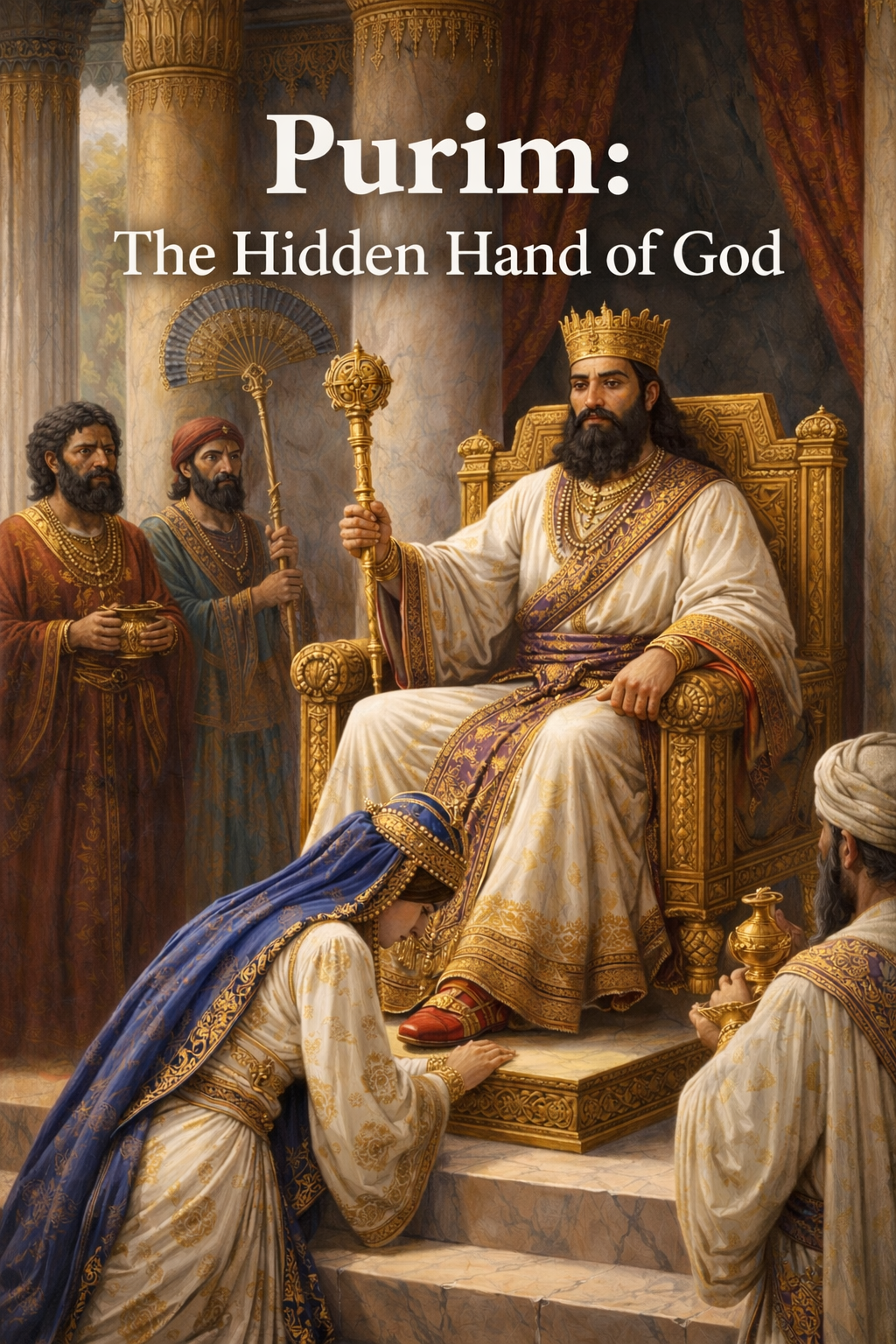
Purim is the biblical celebration of deliverance that comes from the story of Esther. When you read the book of Esther you may notice something that God’s name is never mentioned once, and yet His fingerprints are on every page.
It takes place in a time when the Jewish people, living in exile under Persian rule, were marked for destruction… but the Father overturned the entire plot.
Purim is a yearly reminder that even when God seems hidden, He is still on the throne.
How it All Began
When the Jewish people were in exile, scattered throughout the empire of Persia, they were under the rule of King Achashverosh (Xerxes.)
The Book of Esther records that the king held a lavish royal feast, with countless rulers from all over the empire in attendance. This celebration lasted several days and no expense was spared. The men partied together, and the women had their own celebrations. At the finale, the king summoned his wife, Queen Vashti to be brought before the guests to display her beauty (Esther 1:10–11). Vashti refused to come.
“But Queen Vashti refused to come at the order of the king, which he had sent through his officers. This enraged the king — his anger blazed inside him.”
—Esther 1:12
That refusal set off a chain reaction. The king’s advisors feared Vashti’s defiance would encourage disrespect throughout the empire, so they counseled the king to remove her from her position.
“ If it pleases his majesty, let him issue a royal decree — and let it be written as one of the laws of the Persians and Medes, which are irrevocable — that Vashti is never again to be admitted into the presence of King Achashverosh, and that the king give her royal position to someone better than she.”
—Esther 1:19
And so Vashti was deposed (Esther 1:19–22). Later, his servants suggested that he gather beautiful young women from across the empire and let the king choose a new queen.
“The king’s servants attending him said, “A search should be made for young, good-looking virgins. The king should appoint officials in all the provinces of the kingdom to gather all the young, good-looking virgins to the house for the harem, in Shushan the capital. They should be put under the care of Hegai the king’s officer in charge of the women, and he should give them the cosmetics they require. Then, the girl who seems best to the king should become queen instead of Vashti.” This proposal pleased the king, so he acted accordingly.”
—Esther 2:2–4
This was not a romantic storybook moment. It was an imperial system. It was powerful, intimidating, and risky. And into that system, Esther was taken.
Esther was a Jewish orphan, raised by her cousin Mordecai:
“He had raised Hadassah, that is, Ester, his uncle’s daughter; because she had neither father nor mother. The girl was shapely and good-looking; after her father’s and mother’s death, Mordekhai had adopted her as his own daughter.”
—Esther 2:7
When the king’s command went out, Esther was brought into the palace among the women gathered for this selection (Esther 2:8). She entered a period of preparation that lasted twelve months:
“Each girl had her turn to appear before King Achashverosh after she had undergone the full twelve-month preparation period prescribed for the women, consisting of a six-month treatment with oil of myrrh and six months with perfumes and other cosmetics for women.”
—Esther 2:12
During this time, Esther found favor in the eyes of the chief officer over the women.
“The girl pleased him and won his favor, so that he lost no time in giving her her cosmetics, her portions [of special food] and seven girls from the king’s palace to attend her; he also promoted her and the girls attending her to the best place in the harem’s quarters.”
—Esther 2:9
Mordecai instructed her not to reveal her Jewish identity.
“ Ester did not disclose her people or family ties, because Mordekhai had instructed her not to tell anyone.”
—Esther 2:10
Then came the day Esther was brought before the king, and it was her that he chose.
“The king liked Ester more than any of his wives; none of the other virgins obtained such favor and approval from him. So he put the royal crown on her head and made her queen in place of Vashti.”
—Esther 2:17
In other words: an orphaned Jewish girl living in exile, became queen of the most powerful empire of her day. Because, unseen to everyone else, the Father was positioning her exactly where she needed to be.
The deliverance was being prepared before the danger was even presented.
The Plot
Haman was a member of the king’s court. He rose in power, and in pride. When Mordecai would not bow before him, Haman’s rage grew. Scripture says:
“However, on learning what people Mordekhai belonged to, it seemed to him a waste to lay hands on Mordekhai alone. Rather, he decided to destroy all of Mordekhai’s people, the Jews, throughout the whole of Achashverosh’s kingdom.”
—Esther 3:6
After a series of events, including Mordecai being honored by the king, and Haman having to actually carry it out – filling him with even more rage, he devised a plan to deceive the king into having all the Jews killed.
Haman cast lots to choose the date for destruction.
“ In the first month, the month of Nisan, in the twelfth year of Achashverosh, they began throwing pur (that is, they cast lots) before Haman every day and every month until the twelfth month, which is the month of Adar.”
—Esther 3:7
A decree was written, sealed, and sent throughout the empire (Esther 3:13). From a human perspective, it looked ominous.
“For Such a Time as This”
When Mordecai learned of the decree, he mourned publicly in sack cloth and ashes (Esther 4:1). Esther heard and sent new clothes to him, but Mordecai refused. He wanted her to feel the weight of what was happening, and implored her to intervene with the king on behalf of her people.
He sent her a clear message: you were placed where you are for a reason.
“For if you fail to speak up now, relief and deliverance will come to the Jews from a different direction; but you and your father’s family will perish. Who knows whether you didn’t come into your royal position precisely for such a time as this.”
—Esther 4:14
Esther knew the risk. Anyone who approached the king uninvited could be put to death unless the king extended mercy (Esther 4:11). But she chose courage and called for a fast:
““Go, assemble all the Jews to be found in Shushan, and have them fast for me, neither eating nor drinking for three days, night and day; also I and the girls attending me will fast the same way. Then I will go in to the king, which is against the law; and if I perish, I perish.”
—Esther 4:16
The Hidden Hand of God and the Great Reversal
God’s hand is seen as the story unfolds with Esther having the wisdom in how and when she would reveal who she was and to speak on behalf of her people.
When the king realized Haman’s deception, and how it would even mean the death of his queen, he was furious!
Haman’s plan to kill all the Jews, led instead to his own death.
“So they hanged Haman on the gallows he had prepared for Mordekhai. Then the king’s anger subsided.”
—Esther 7:10
Haman was gone, but the decree to kill all the Jews had already been established. In Persian law, once something was decreed, it was permanent. It couldn’t simply be revoked, so a second decree was issued allowing the Jews to defend themselves (Esther 8:11).
“The time approached for the king’s order and decree to be carried out, the day when the enemies of the Jews hoped to overpower them. But, as it turned out, the opposite took place — the Jews overpowered those who hated them. Thus, on the thirteenth day of the twelfth month, the month of Adar,
—Esther 9:1
Why It’s Called Purim
Purim is the word “lots” and the celebration is simply named after the lots Haman cast.
The very “tool” used to plan evil became the memorial of defeat:
“because Haman the son of Hamdata the Agagi, the enemy of the Jews, had plotted against the Jews to destroy them and had thrown pur (that is, “cast lots”) to crush and destroy them;”
—Esther 9:24
What was meant for destruction became deliverance.
Why a Christian Might Want to Participate
Purim is not about “trying to become Jewish.” It’s about honoring the God of Scripture and learning His ways through His Word.
Purim reminds believers that God is working even when He feels quiet or hidden. And it also connects believers to the ongoing story of God’s people.
Purim anchors us in the reality that the God we worship is faithful to preserve His covenant people.
How Purim Is Observed
Purim does not appear in Leviticus 23 because it is not one of God’s appointed times. It was established by man as a remembrance of events that occurred later in Israel’s history, during the exile. But it is still a biblically grounded celebration tied to real events recorded in the Word.
Purim is established directly in Scripture in Esther 9. After deliverance came, Mordecai and Esther sent letters throughout the Persian Empire to establish an annual remembrance:
“[to commemorate] the days on which the Jews obtained rest from their enemies and the month which for them was turned from sorrow into gladness and from mourning into a holiday; they were to make them days of celebrating and rejoicing, sending portions [of food] to each other and giving gifts to the poor.”
—Esther 9:22
And Scripture emphasizes that these days were to be remembered continually:
“and that these days would be remembered and observed throughout every generation, every family, every province and every city; and that these days of Purim would never cease among the Jews or their memory be lost by their descendants.”
—Esther 9:28
So biblically, Purim includes:
- Feasting and rejoicing
- Sharing food portions with others
- Giving to the poor
Purim is traditionally a day to read the book of Esther, and it is often read aloud.
Some fellowships will even have children act out the story as it is read. When Mordecai’s name is mentioned, everyone cheers! But when Haman’s name is mentioned, everyone boos and hisses! It is a fun day for the children to participate and learn the story.
Another common tradition is to make Hamantaschen (or hamantashen) and share them with others. Hamantaschen are triangle shaped cookies that are filled with jam or jelly.
There is a legend that Haman wore a triangle hat, and the cookies represent it. There’s also a story that Haman had pointy, triangle ears. Whether there is any truth to those tales is of no consequence. It is a fun (and delicious) tradition. You can get a recipe for hamantaschen cookies here.
The Heart of Purim: The Father Can Flip the Story
The book of Esther describes danger being transformed into victory, and sorrow into joy.
That is Purim.
It is a yearly reminder that what the enemy intends for evil, can be flipped and used for good. All because the God of Israel still reigns.