What does God say in His Word about whether He will accept this or not.
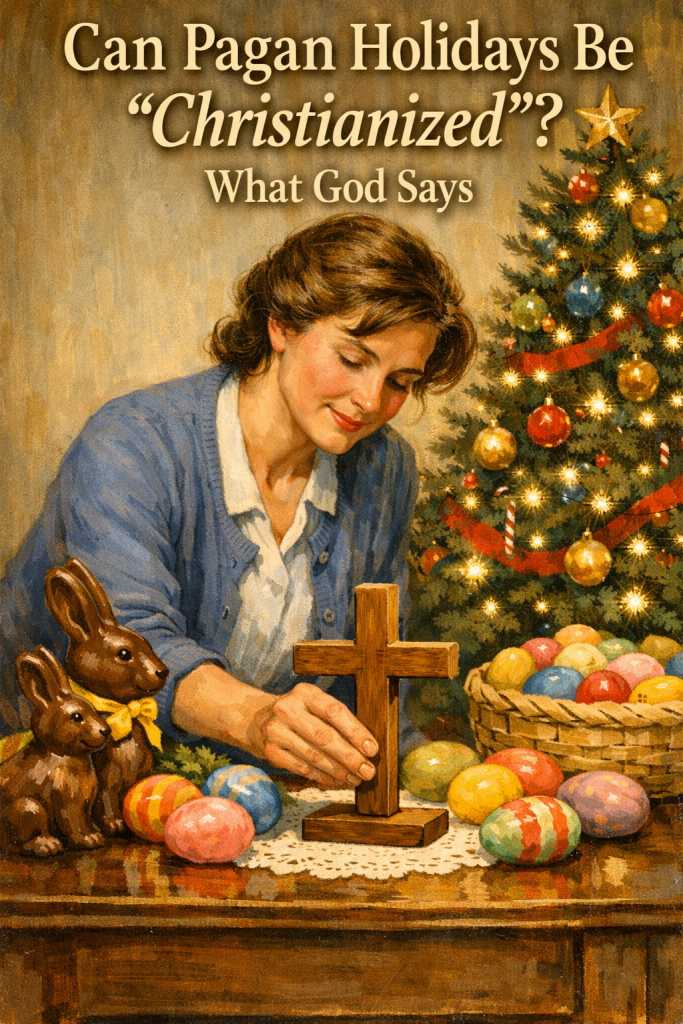
In many churches and Christian homes today, certain holidays are celebrated “for Jesus” even though their roots come from things like pagan worship, fertility rites, or ancient sun festivals.
Often, believers are told, “It doesn’t matter where it came from—what matters is our intention.”
Others say, “We’ve redeemed it for Christ.”
But is that actually what Scripture teaches?
Does the Bible say that God is pleased when His people take pagan traditions and give them Christian names? Can these things be “redeemed?”
Or does God call His people to something different?
When we open the Word, we find that this is not a new question. God’s people have faced this temptation for thousands of year, and He has spoken very clearly about it.
God’s Clear Warning: Do Not Copy Pagan Worship
When Israel entered the Promised Land after their time wandering in the desert, they were surrounded by nations who worshiped false gods through festivals, symbols, and rituals. God knew His people would be tempted to copy what they saw. Because of this, He warned them sternly and directly.
“be careful, after they have been destroyed ahead of you, not to be trapped into following them; so that you inquire after their gods and ask, ‘How did these nations serve their gods? I want to do the same.’ You must not do this to Adonai your God! For they have done to their gods all the abominations that Adonai hates! They even burn up their sons and daughters in the fire for their gods!”
—Deuteronomy 12:30–31
God did not say, “You may use their customs if you mean well.”
He said, “You shall not worship Me that way.” Likewise, He commanded:
“Here is what Adonai says: “Don’t learn the way of the Goyim (nations), don’t be frightened by astrological signs, even if the Goyim are afraid of them;”
—Jeremiah 10:2
“You are not to worship their gods, serve them or follow their practices; rather, you are to demolish them completely and smash their standing-stones to pieces.”
—Exodus 23:24
From the beginning, God made it clear: His worship is not to be shaped by the culture around them.
Sincere Intentions Do Not Make False Worship Acceptable
Many believers today sincerely love God. They are not trying to rebel. They truly want to honor Him. They’re simply doing the things they grew up doing or were taught in their churches or by family.
But Scripture shows that sincerity alone does not make worship acceptable.
The Golden Calf: Worshiping God in a Pagan Way
When Israel made the golden calf, they were not rejecting God. as we see in Exodus.
“On seeing this, Aharon built an altar in front of it and proclaimed, “Tomorrow is to be a feast for Adonai.”
—Exodus 32:5
They sincerely thought they were worshiping the God who brough them out of Egypt, but they used a pagan-style idol to worship Yahweh.
And God was furious.
He judged them severely for it.
“Adonai said to Moshe, “Go down! Hurry! Your people, whom you brought up from the land of Egypt, have become corrupt! So quickly they have turned aside from the way I ordered them to follow! They have cast a metal statue of a calf, worshipped it, sacrificed to it and said, ‘Isra’el! Here is your god, who brought you up from the land of Egypt!’” Adonai continued speaking to Moshe: “I have been watching these people; and you can see how stiffnecked they are. Now leave me alone, so that my anger can blaze against them, and I can put an end to them! I will make a great nation out of you instead.”
—Exodus 32:7–10
Their intentions did not protect them from consequences.
Nadab and Abihu: Unauthorized Worship
Aaron’s sons violated the instructions they had been given, and offered “strange fire” before the Lord:
“But Nadav and Avihu, sons of Aharon, each took his censer, put fire in it, laid incense on it, and offered unauthorized fire before Adonai, something he had not ordered them to do.”
—Leviticus 10:1
For doing this, God struck them dead.
Why?
Because God takes His worship seriously. He does not accept creativity that ignores His instructions. This shows clearly, again, that intention behind the actions isn’t what matters.
Saul: Obedience Over Sacrifice
King Saul ignored God’s instructions and made a sacrifice that he didn’t have the authority to do, because he was being impatient. He tried to justify his disobedience.
But Samuel told him:
“Sh’mu’el said, “Does Adonai take as much pleasure in burnt offerings and sacrifices as in obeying what Adonai says? Surely obeying is better than sacrifice, and heeding orders than the fat of rams.”
—1 Samuel 15:22
God desires obedience, not religious shortcuts.
God Calls His People to Be Separate
Throughout the Bible, God calls His people to be distinct. They are not to blend into their surrounding culture.
“Rather, you people are to be holy for me; because I, Adonai, am holy; and I have set you apart from the other peoples, so that you can belong to me.”
—Leviticus 20:26
“Therefore Adonai says,‘Go out from their midst; separate yourselves; don’t even touch what is unclean. Then I myself will receive you.”
—2 Corinthians 6:17
“In other words, do not let yourselves be conformed to the standards of the ‘olam hazeh. Instead, keep letting yourselves be transformed by the renewing of your minds; so that you will know what God wants and will agree that what he wants is good, satisfying and able to succeed.”
—Romans 12:2
Biblical faith is not about fitting in with the world we live in. It is about being faithful to the One we serve.
Pagan Associations Matter to God
Some argue, “The old meanings of these things are gone. We’ve changed them.”
But Scripture shows that God cares very much about where these practices come from.
Hosea: God Even Removes Pagan Language
“…you will no longer call me Ba‘ali [My Master]. For I will remove the names of the ba‘alim from her mouth; they will never again be mentioned by name.”
—Hosea 2:18-19 (16-17)
Interestingly this was a term used that meant “owner, master or lord.” It was a word the pagans used, and you can see it used for the one true God in a few places through scripture.
But even words connected to pagan worship were unacceptable to God.
Ezekiel: Mixing Sun Worship with Temple Worship
In Ezekiel’s vision, men were worshiping God while facing the rising sun, a pagan practice. What did God think of that? He called it an “abomination.”
“He brought me into the inner courtyard of Adonai’s house; and there, at the entrance to the temple of Adonai, between the porch and the altar, were about twenty-five men with their backs toward the temple of Adonai and their faces toward the east; and they were worshipping the sun toward the east. He asked me, “Human being, have you seen this? Does the house of Y’hudah consider it a casual matter that they commit the disgusting practices they are committing here, thus filling the land with violence, provoking me still more? Look! They are even putting the branch to their nose! Therefore I will act in fury, my eye will not spare, I will have no pity. Even if they cry loudly right in my ears, I will not listen to them.”
—Ezekiel 8:16–18
They were mixing true worship with false symbolism, and God rejected it in the strongest terms.
The Apostles Warned Against Religious Mixture
The New Testament continues the same teaching.
Paul’s Warning
“No, what I am saying is that the things which pagans sacrifice, they sacrifice not to God but to demons; and I don’t want you to become sharers of the demons! You can’t drink both a cup of the Lord and a cup of demons, you can’t partake in both a meal of the Lord and a meal of demons.”
—1 Corinthians 10:20–21
Paul did not say pagan practices could be repurposed.
He said they were spiritually dangerous.
Acts 15: Gentile Believers
When Gentiles came to faith in the one true God of Abraham, Isaac and Jacob, the apostles instructed them to leave behind all traces of their pagan practices.
“Therefore, my opinion is that we should not put obstacles in the way of the Goyim who are turning to God. Instead, we should write them a letter telling them to abstain from things polluted by idols, from fornication, from what is strangled and from blood.”
—Acts 15:19–20
They were not told to “Christianize” them, and do them to honor Yahweh instead. They were told to abandon them.
Yeshua Warned Against Man-Made Religious Traditions
Yeshua (Jesus) confronted religious leaders who elevated manmade tradition over God’s commands:
“Indeed,” he said to them, “you have made a fine art of departing from God’s command in order to keep your tradition!”
—Mark 7:9
Tradition in general is not automatically evil. But tradition that replaces or corrupts God’s instructions is.
God Already Gave His Appointed Times
Instead of borrowing pagan festivals, God gave His own sacred calendar.
“Tell the people of Isra’el: ‘The designated times of Adonai which you are to proclaim as holy convocations are my designated times.”
—Leviticus 23:2
We know these appointed times (moedim) or feasts as: Passover, Unleavened Bread (Matzoh), Firstfruits, Shavuot (Pentecost), Trumpets, Atonement (Yom Kippur), and Tabernacles (Booths).
These were designed to teach His people about redemption, repentance, Messiah, and the Kingdom. As you begun to study God’s appointed times, you won’t be able to help but see how each and every one of them poing to Messiah.
The spring feasts of Passover, Unleavened Bread, Firstfruits and Shavuot all point to Yeshua’s first coming.
The fall feasts of Trumpets, Atonement and Tabernacles all point to His second coming. But we will study each of these in separate articles later.
Nowhere does Scripture say these holy days of God should be replaced with festivals that are borrowed from the “nations.”
What About “Let No One Judge You for Days”?
Some quote:
“So don’t let anyone pass judgment on you in connection with eating and drinking, or in regard to a Jewish festival or Rosh-Hodesh or Shabbat.”
—Colossians 2:16
“One person considers some days more holy than others, while someone else regards them as being all alike. What is important is for each to be fully convinced in his own mind.”
—Romans 14:5
These passages deal with completely different topics.
The passage in Colossians is encouraging the once pagan, now Christian believers to not worry about others judging them for following God’s days.
The passage in Romans was a debate about fasting. In those days it was customary to fast every week. The day(s) that people fasted was a frequent topic of debate during those times.
Context always matters with all scripture.
Paul never approved of adopting pagan rituals.
The Pattern of Scripture Is Clear
From Genesis to Revelation, the message is consistent.
- God Himself defines how He is worshiped.
- He rejects the mixing of religious practices.
- God calls His people to be set apart from the nations around them.
- He values obedience over traditions.
- God strictly warns against spiritual compromise.
There is no biblical command or example anywhere in the scriptures supporting the “Christianizing” of pagan holidays anywhere in the Bible.
A Gentle Word to Believers
Many sincere Christians have never been taught these things.
They grew up in traditions.
They trusted pastors and churches.
They assumed everything was fine.
God is not looking for perfection overnight.
He is looking for hearts that are willing to learn and obey.
“If anyone wants to do his will, he will know whether my teaching is from God or I speak on my own.”
—John 7:17
When God shows us truth, He invites us to walk in it—step by step.
Prayerful Reflection
Ask yourself prayerfully and truthfully the following questions:
Am I following manmade traditions or what God’s Word says?
Do I study God’s instructions for myself, or do I listen to others that teach something else?
Does any man have the authority to overrule God’s instructions?
Do I desire truth more than comfortable traditions?
And probably the hardest question: Am I willing to change when He convicts me?
Walking in Torah is not about being “better” than others. It is about walking faithfully with God, and when we learn better, we do better.
Father,
Thank You for Your Word that guides us in truth. Thank You for Your patience with us as we learn. Give us hearts that desire obedience more than tradition. Open our eyes to anything in our lives that does not honor You. Teach us to worship You in spirit and in truth. And help us walk faithfully in Your ways.
In Yeshua’s name, Amen.