In today’s world, it has become very easy to call oneself a “Christian.” In many communities, Christianity is woven into culture, family traditions, holidays, and social expectations. People grow up attending church, celebrating Christmas and Easter, and hearing Bible stories from childhood. Over time, “being Christian” can feel almost automatic.
Yet Scripture shows us that following Yeshua (Jesus) was never meant to be routine, tradition or just cultural. He did not come to establish a comfortable religious culture. He came to call people into transformed lives of discipleship.
In ancient Jewish culture, disciples were known for something very simple and very revealing:
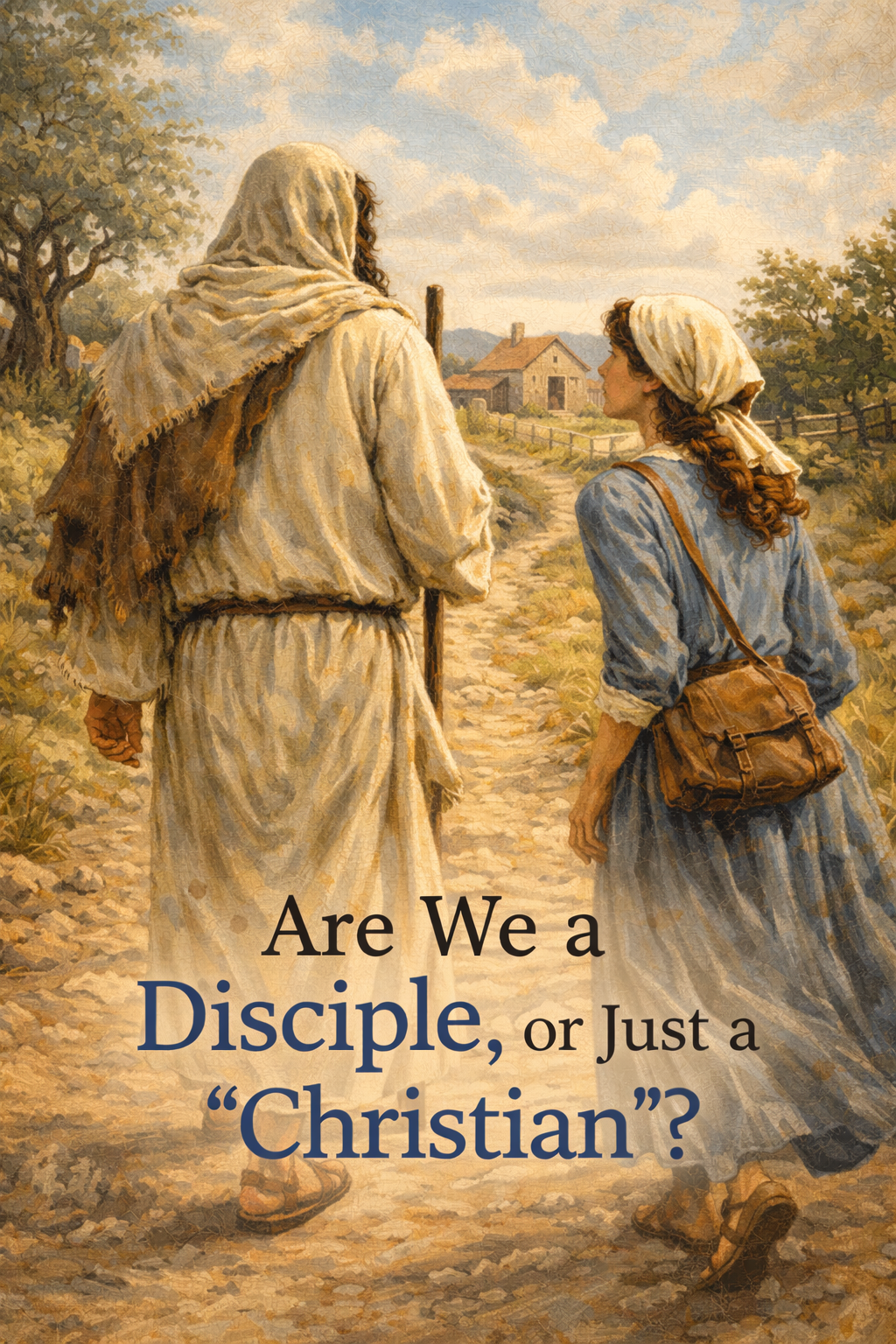
They were dusty. Not from neglect, but from devotion.
They walked so closely behind their teacher that the dust from his feet clung to their clothing. Over time, this gave rise to a beautiful expression:
“Walk in the dust of the Rabbi.”
It described a life of wholehearted discipleship. A life shaped by following God’s ways so closely that His walk became our walk.
Today, this image speaks powerfully to believers. It helps us understand the difference between true discipleship and the kind of comfortable, cultural Christianity that is so common in modern society.
One produces dusty feet and transformed lives.
The other often produces religious routines with limited or little change.
The Ancient Picture of Discipleship
This idea of “walking in the dust of the rabbi” comes from an ancient Jewish teaching.
“Let your house be a meeting place for the wise, and cover yourself in the dust of their feet, and drink in their words with thirst.”
—Pirkei Avot 1:4
In biblical times, rabbis did not teach only in classrooms. They taught while walking. Their students followed closely behind on dusty roads.
If you were serious about learning, you stayed near enough to hear every word and observe every action.
By the end of the day, your clothing showed where you had been. You were covered in your teacher’s dust.
That dust was evidence of dedication. Discipleship was not part-time learning. It was a way of life.
When Yeshua Said “Follow Me”
This background helps us understand how radical Yeshua’s call truly was.
“Yeshua said to them, “Come after me, and I will make you fishers for men!”
—Matthew 4:19
When He said to “Come after me” or in some translations “Follow me” — He was not inviting people to attend occasional sermons. He was inviting them into this ancient model of discipleship.
To follow Him, He is telling them to “leave your former life. To walk My path, learn My ways, and become like Me.”
Those who accepted His call did exactly that. They were willing to leave everything behind – jobs, family…everything!
They walked with Him, ate with Him, listened to Him, watched how He treated people, observed how He prayed, and learned how He obeyed the Father.
They were literally and spiritually walking in His dust.
Cultural Christianity
In contrast, much of modern Christianity looks very different.
Many people today identify as Christians because of family background, tradition, or culture. They may attend church, celebrate “Christian” holidays, and use Christian language. Yet their daily lives are often shaped more by society than by Scripture.
This is what we might call cultural Christianity.
It is faith that fits comfortably into the world. It does not require deep surrender. It rarely demands sacrifice, and often avoids discomfort.
Yeshua warned:
“These people honor me with their lips, but their hearts are far away from me.”
—Matthew 15:8
They know about Him, say they believe in Him, but they do not truly follow Him.
A Disciple Walks Close Enough to Get Dusty
A true disciple does not follow from a distance. A disciple walks close enough to be affected by the walk.
Close enough to hear correction. Close enough to see the example given. Close enough to be changed by what he or she experiences, witnesses and learns.
Yeshua said:
“It is enough for a talmid that he become like his rabbi, and a slave like his master. Now if people have called the head of the house Ba‘al-Zibbul, how much more will they malign the members of his household!”
—Matthew 10:25
You will notice that He said that people will likely not like it when you walk as He walked.
He also said,
“A person who claims to be continuing in union with him ought to conduct his life the way he did.”
—1 John 2:6
This is dusty faith. Faith that follows closely, imitates. A faith that learns through daily obedience.
Discipleship is not about admiration, it is about imitation.
Obedience Is the Footprint of Love
One of the clearest signs of true discipleship is obedience.
Yeshua said:
“If you love Me, you will keep My commandments”
—John 14:15
Love for God is not measured just by emotion alone. It is revealed through faithful obedience to His instructions.
A disciple asks, “What does God’s Word say, and how do I live it?” Even when obedience is inconvenient, unpopular, or costly, the disciple chooses faithfulness.
Scripture also warns about saying you are a disciple, but not doing what He says.
“Why do you call me, ‘Lord! Lord!’ but not do what I say?”
—Luke 6:46
Transformation Comes from Walking Close
When we walk closely with Yeshua, we cannot remain unchanged.
Paul wrote:
“In other words, do not let yourselves be conformed to the standards of the ‘olam hazeh. Instead, keep letting yourselves be transformed by the renewing of your minds; so that you will know what God wants and will agree that what he wants is good, satisfying and able to succeed.”
—Romans 12:2
God’s Word confronts us, His holiness refines us, and His example leads us.
James reminds us:
“Don’t deceive yourselves by only hearing what the Word says, but do it!”
—James 1:22
This transformation happens through studying His word and daily walking with Him.
Cultural Christianity often lacks this change, and Paul warns about this superficial form of Christianity.
“as they retain the outer form of religion but deny its power. Stay away from these people!”
—2 Timothy 3:5
There is activity in the person’s life, giving an appearance of Christian faith, but little of the fruit described in the scriptures.
Is fruit necessary?
“Already the axe is at the root of the trees, ready to strike; every tree that doesn’t produce good fruit will be chopped down and thrown in the fire!”
—Matthew 3:10
The warning about the need for obvious spiritual fruit can not be emphasized enough, especially when you look at our Messiah’s own words.
“Beware of the false prophets! They come to you wearing sheep’s clothing, but underneath they are hungry wolves! You will recognize them by their fruit. Can people pick grapes from thorn bushes, or figs from thistles? Likewise, every healthy tree produces good fruit, but a poor tree produces bad fruit. A healthy tree cannot bear bad fruit, or a poor tree good fruit. Any tree that does not produce good fruit is cut down and thrown in the fire! So you will recognize them by their fruit.
—Matthew 7:15-20
After that stern warning, He then goes on to express some of the scariest words in all the Scriptures.
“Not everyone who says to me, ‘Lord, Lord!’ will enter the Kingdom of Heaven, only those who do what my Father in heaven wants. On that Day, many will say to me, ‘Lord, Lord! Didn’t we prophesy in your name? Didn’t we expel demons in your name? Didn’t we perform many miracles in your name?’ Then I will tell them to their faces, ‘I never knew you! Get away from me, you workers of lawlessness!’
— Matthew 7:21-23
These people He is speaking to, call themselves Christians. They do all sorts of things in His name, but Yeshua says they are not His, that He never even knew them! He calls them workers of lawlessness – people without God’s laws – the Torah.
This should be incredibly sobering.
The Importance of Real Relationship
The be in discipleship, you must be in a close relationship with Himm
Yeshua said:
“Stay united with me, as I will with you — for just as the branch can’t put forth fruit by itself apart from the vine, so you can’t bear fruit apart from me.”
—John 15:4
A disciple seeks daily fellowship with God through prayer, Scripture, repentance, and worship. But it doesn’t have to be hard, all we have to do is sincerely seek it.
“Come close to God, and he will come close to you. Clean your hands, sinners; and purify your hearts, you double-minded people!”
—James 4:8
Torah: The Path He Walked
Again, to walk in the dust of the Rabbi is to walk in His ways.
Scripture says:
“How happy are those whose way of life is blameless, who live by the Torah of Adonai!”
—Psalm 119:1
and
“Your word is a lamp for my foot and light on my path.”
—Psalm 119:105
Yeshua Himself walked in perfect obedience to the Torah, God’s instructions. If He hadn’t, He couldn’t have been the perfect, spotless lamb to take on the punishment of our sins.
John wrote:
“A person who claims to be continuing in union with him ought to conduct his life the way he did.”
—1 John 2:6
Torah is not bondage, it is God’s plan and instructions for our lives.
Counting the Cost
Walking in the footsteps of our Messiah, does not come easy. There is often and most likely a cost to doing so. Sometimes even the greatest cost.
“Whoever does not carry his own execution-stake and come after me cannot be my talmid.”
—Luke 14:27
To be a true discipleship involves complete surrender.
Yeshua also warned:
“ For whoever tries to save his own life will destroy it, but whoever destroys his life on my account will save it.”
—Luke 9:24
If you try to walk with Him, while also preserving the life you had before…you have split loyalties. We must be willing to give up everything, even if it means losing our lives. Give up our earthly lives, so that we can have a greater live in Him.
What Dusty Disciples Look Like Today
Paul wrote:
“Well, whatever you do, whether it’s eating or drinking or anything else, do it all so as to bring glory to God.”
—1 Corinthians 10:31
We have to make sure that every action we take, no matter how small, is done in a way that honors our Father.
Walking in the dust today means choosing obedience over what familiar customs. Choosing following the Scriptures over the culture. It means choosing faithfulness over being popular. And it means choosing to seek what is true rather than what is easy.
This kind of faith shapes every part of a disciple’s life.
Choosing the Narrow Way
Yeshua said:
“Go in through the narrow gate; for the gate that leads to destruction is wide and the road broad, and many travel it; but it is a narrow gate and a hard road that leads to life, and only a few find it.”
—Matthew 7:13-14
If “everybody” is living a version of Christianity, is it likely to be the “Narrow way?” Odds are, there may be something more to it.
We are told to walk the narrow path that few find, and the Word says that only the narrow way leads to life.
Questions to Ask Yourself
Below are a handful of questions to ask yourself, prayerfully and honestly.
- Am I walking more closely to my Messiah, or to the other Christians around me?
- What habits do I have that draw me nearer to His path? Which pull me away?
- If someone followed my walk, would it lead them closer to Messiah?
- Am I willing to walk closer to my Messiah, even if my friends, family or church members don’t understand me?
- Am I willing to give up everything for Him, and allow Him to transform me?
Prayerful Reflections
In Psalm 119 the psalmist prayed:
“Teach me, Adonai, the way of your laws; keeping them will be its own reward for me.”
—Psalm 119:33
This should be our own prayer.
We should want to walk in the ways of our Messiah, simply because we love Him, and for the sake of knowing that it would please Him.
To walk in the steps of our Messiah is to live in continual pursuit of God’s ways. It is not about perfection, but about devotion to Him.
May we be known as His faithful followers, and for the reflection of Him in our lives, no matter the cost.