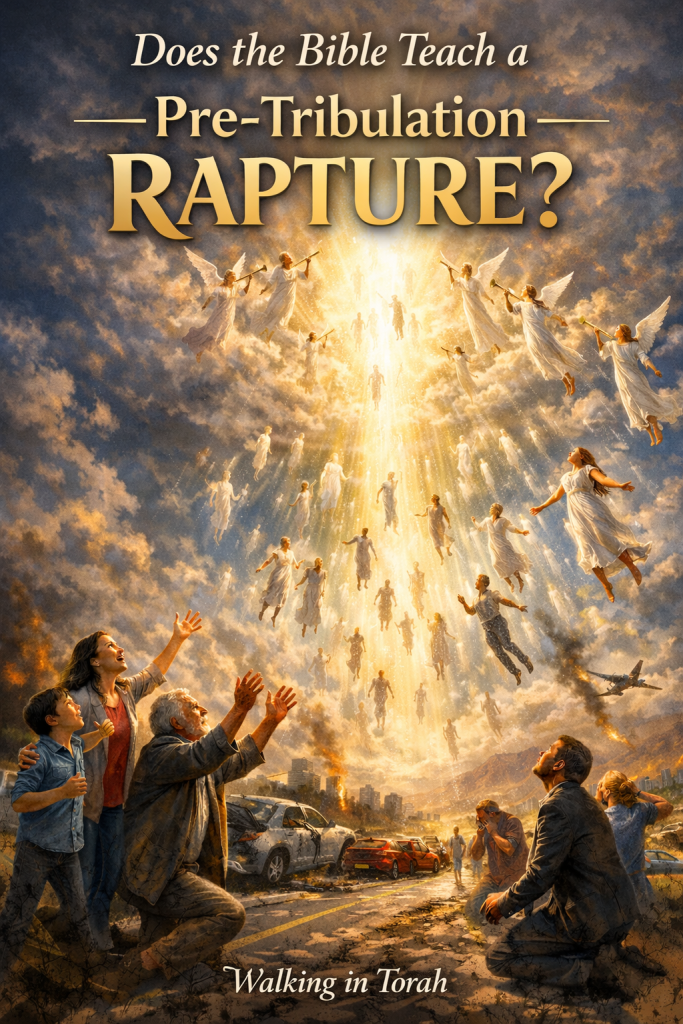
For many believers, the idea of a rapture—where followers of Messiah are suddenly taken away before a time of great suffering—has become almost assumed. This teaching has been especially popularized by the “Left Behind” series and countless other books and movies. But when we slow down and open the Bible and read carefully, we must ask a very important question: Does the Bible actually teach that the “rapture” happens before the Great Tribulation?
The Short Answer
No verse in Scripture explicitly teaches a pre-tribulation rapture.
While some passages are used to support the idea, other verses speak very plainly about believers remaining on earth during tribulation and being gathered after it.
Let’s walk through the Word together and examine every major passage used to support a pre-tribulation rapture. Then we’ll compare them to what Scripture clearly says about the timing of Messiah’s return and the gathering of His people.
Let’s look at both sides carefully.
Scriptures Commonly Used to Support a Pre-Tribulation Rapture
“Not Appointed to Wrath”
“For God has not intended that we should experience his fury, but that we should gain deliverance through our Lord Yeshua the Messiah.” —1 Thessalonians 5:9
This verse is often used to say that Tribulation = God’s fury or wrath. Therefore believers have to be removed before it begins.
But the Scriptures actually demonstrate that tribulation and fury or wrath are not the same thing.
Believers do experience tribulation.
“I have said these things to you so that, united with me, you may have shalom. In the world, you have tsuris. But be brave! I have conquered the world!” —John 16:33
The word “tsuris” in the Greek is thlipsis. It is defined as afflicted/affliction, anguish, burdened, persecution, trouble, tribulation. We as believers will have these things. We’ll mention this scripture a few times in this arcticle.
God’s fury, however, is poured out on the unrepentant.
“and said to the mountains and rocks, “Fall on us, and hide us from the face of the One sitting on the throne and from the fury of the Lamb! For the Great Day of their fury has come, and who can stand?”” —Revelation 6:16-17, Hosea 10:8
Tribulation is something believers will endure.
Fury/Wrath is something God pours out on the wicked.
They are not the same thing.
“Kept From the Time of Trial”
“Because you did obey my message about persevering, I will keep you from the time of trial coming upon the whole world to put the people living on earth to the test.” —Revelation 3:10
Some interpret “keep you from” to mean that the believers will be physically removed from the earth. But Scripture uses the same idea elsewhere.
“I don’t ask you to take them out of the world, but to protect them from the Evil One.” —John 17:15
Here, “protect them from” (sometimes translated as “keep you from” in some bibles) clearly means protected within the world, not removed from the world.
So the phrase in Revelation 3:10 fits the same pattern of protection not evacuation.
The “Restrainer” Being Removed
“And now you know what is restraining, so that he may be revealed in his own time. For already this separating from Torah is at work secretly, but it will be secretly only until he who is restraining is out of the way.” —2 Thessalonians 2:6-7
Some people believe that the “restrainer” is the Holy Spirit, therefore the church must be removed during this time.
But the Bible never identifies who exactly the restrainer is.
But we know that the Holy Spirit cannot be removed from the earth.
“Where can I go to escape your Spirit? Where can I flee from your presence?”—Psalm 139:7
There is no biblical support for the idea that the Holy Spirit leaves the world.
“Like a Thief in the Night”
“because you yourselves well know that the Day of the Lord will come like a thief in the night.” —1 Thessalonians 5:2
This is often used to suggest a secret coming that no one can expect or anticipate. But they should really keep reading. Is that what Paul is saying?
“But you, brothers, are not in the dark, so that the Day should take you by surprise like a thief; for you are all people who belong to the light, who belong to the day. We don’t belong to the night or to darkness, so let’s not be asleep, like the rest are; on the contrary, let us stay alert and sober. People who sleep, sleep at night; and people who get drunk, get drunk at night. But since we belong to the day, let us stay sober, putting on trust and love as a breastplate and the hope of being delivered as a helmet”
—1 Thessalonians 5:4-8
So what is this saying? That it is a surprise for unbelievers who are in darkness. That it is not a surprise for those paying attention and walking in the light.
Messiah’s return is not hidden—it is unexpected only for the unprepared.
Scriptures That Clearly Refute a Pre-Tribulation Rapture
The following Bible passages speak very plainly about the timing of the return of our Messiah.
Yeshua (Jesus) Says the Gathering Happens After Tribulation
“But immediately following the trouble of those times, the sun will grow dark, the moon will stop shining, the stars will fall from the sky, and the powers in heaven will be shaken.
Then the sign of the Son of Man will appear in the sky, all the tribes of the Land will mourn, and they will see the Son of Man coming on the clouds of heaven with tremendous power and glory. He will send out his angels with a great shofar; and they will gather together his chosen people from the four winds, from one end of heaven to the other.”—Matthew 24:29-31
Note that this is the same gathering, the same trumpet, the same event described in other “rapture” passages.
And it happens after tribulation.
Paul Says the Antichrist Comes First
“But in connection with the coming of our Lord Yeshua the Messiah and our gathering together to meet him, we ask you, brothers, not to be easily shaken in your thinking or anxious because of a spirit or a spoken message or a letter supposedly from us claiming that the Day of the Lord has already come. Don’t let anyone deceive you in any way.
For the Day will not come until after the Apostasy has come and the man who separates himself from Torah has been revealed, the one destined for doom. He will oppose himself to everything that people call a god or make an object of worship; he will put himself above them all, so that he will sit in the Temple of God and proclaim that he himself is God.”
—2 Thessalonians 2:1-4
Paul is clear that the believers are still present, we witness the Antichrist revealed, then Messiah comes. There is no pre-trib escape being taught here.
Saints Endure Tribulation
Depending upon the bible translation that you use, you may see the word “saints.” The bible version that we use here (CJB) uses the phrase “God’s holy people.”
“It was allowed to make war on God’s holy people and to defeat them; and it was given authority over every tribe, people, language and nation. —Revelation 13:7
“This is when perseverance is needed on the part of God’s people, those who observe his commands and exercise Yeshua’s faithfulness.” —Revelation 14:12
“Then I saw thrones, and those seated on them received authority to judge. And I saw the souls of those who had been beheaded for testifying about Yeshua and proclaiming the Word of God, also those who had not worshipped the beast or its image and had not received the mark on their foreheads and on their hands. They came to life and ruled with the Messiah for a thousand years.” —Revelation 20:4
If believers were already gone, who are these saints, the holy ones of God, who gave their lives in faithfulness to Him?
The Bible never says these are a “different group” of believers. They are God’s faithful people.
Yeshua Promised Tribulation
Again, we’ll look at the passage from John 16.
““I have said these things to you so that, united with me, you may have shalom. In the world, you have tsuris (problems/trials). But be brave! I have conquered the world!” —John 16:33
And in Acts we read:
“strengthening the talmidim, encouraging them to remain true to the faith, and reminding them that it is through many hardships that we must enter the Kingdom of God. —Acts 14:22
The message is not about an escape, it is about endurance.
The Last Trumpet
We often hear about the reference to the “last trump” (or shofar blast) when Messiah returns. Let’s take a look at that.
“It will take but a moment, the blink of an eye, at the final shofar. For the shofar will sound, and the dead will be raised to live forever, and we too will be changed.” —1 Corinthians 15:52
“The seventh angel sounded his shofar; and there were loud voices in heaven, saying, “The kingdom of the world has become the Kingdom of our Lord and his Messiah, and he will rule forever and ever!”” —Revelation 11:15
The seventh trumpet is the last trumpet. It sounds late in Revelation, not before tribulation.
If the shofar that blasts when Messiah returns takes place before the “Great Tribulation” then it can’t possibly be the last blast, and that would contradict what the Bible actually says.
The Rapture Is Not Secret
When Messiah Yeshua returns, it is His second coming.
Basic math says 1 coming (as Savior) + 1 coming (as King) = 2 comings. 1+1=2
There is an argument stating that “Well, when He comes to rapture the believers out, it isn’t really His “second” coming because it is done in secret.”
But does the Bible say it is a secret? That people will vanish, leaving the rest of the world scratching its head about where they went?
“For the Lord himself will come down from heaven with a rousing cry, with a call from one of the ruling angels, and with God’s shofar; those who died united with the Messiah will be the first to rise.” —1 Thessalonians 4:16
“For when the Son of Man does come, it will be like lightning that flashes out of the east and fills the sky to the western horizon.”
—Matthew 24:27
“Look! He is coming with the clouds! Every eye will see him, including those who pierced him; and all the tribes of the Land will mourn him.” —Revelation 1:7
“Just as human beings have to die once, but after this comes judgment, so also the Messiah, having been offered once to bear the sins of many, will appear a second time, not to deal with sin, but to deliver those who are eagerly waiting for him.”
—Hebrews 9:27-28
These scriptures referring to the return of Yeshua – only one return, not two – describe an event that is loud, visible and public.
Nothing is secret about it.
Where Did Pre-Trib Rapture Doctrine Come From?
If we trace it through history, we don’t find it taught by the early believers or written about by the first generations of the church.
Instead, it begins to surface much later, in the 1800s, when a man named John Nelson Darby began promoting this interpretation.
From there, it gained widespread influence through the Scofield Reference Bible, which placed these ideas directly into the margins of Scripture for readers to absorb.
Over time, those notes shaped modern teaching and seminary instruction. The doctrine then spread across pulpits and prophecy charts.
In this way, the pre-trib rapture became popular, not because it is ancient, but because it is relatively modern. And who doesn’t want to believe that we as believers will be spared the suffering of a Great Tribulation? That sounds great!
However, the pre-tribulation rapture viewpoint is not equally believed worldwide. It is far more prominent in the Western church, especially in the United States.
In contrast, most historic Christian traditions and many older Protestant denominations, do not teach a pre-trib rapture. Likewise, in much of the southern hemisphere (Africa, Asia, the Middle East), believers tend to emphasize endurance through persecution rather than escape from it.
It certainly makes sense that people in other parts of the world dismiss this idea of a “rescue pod” rapture, when they are facing unbelievable, horrific and real persecution. We see stories every week of atrocities being committed against Christians all over: Nigeria, Congo, Syria, Iran, China, North Korea…the list goes on.
Though these sentiments are certainly growing in Europe as well.
In parts of Europe, Christians have faced rising hostility. Recent reports document a sharp increase in anti-Christian hate crimes—over 2,200 incidents in 2024, including arson attacks on churches and personal assaults, as well as the murder of a 76-year-old Spanish monk.
This is also spreading into the government powers. In the UK you can be arrested for praying silently in your head, too close to an abortion clinic, even if you are in your own home.
Many American Christians cling to the idea that Yeshua will swoop in and rescue them before real hardship ever touches their lives, while believers in other parts of the world are literally laying down their lives for their faith—just as Messiah warned that we would be hated for His name. (Matthew 10:22).
The Western church often seeks comfort and escape through the promise of a pre-tribulation rapture, hoping to avoid real suffering altogether, even though Scripture tells us plainly, “that it is through many hardships that we must enter the Kingdom of God.” (Acts 14:22).
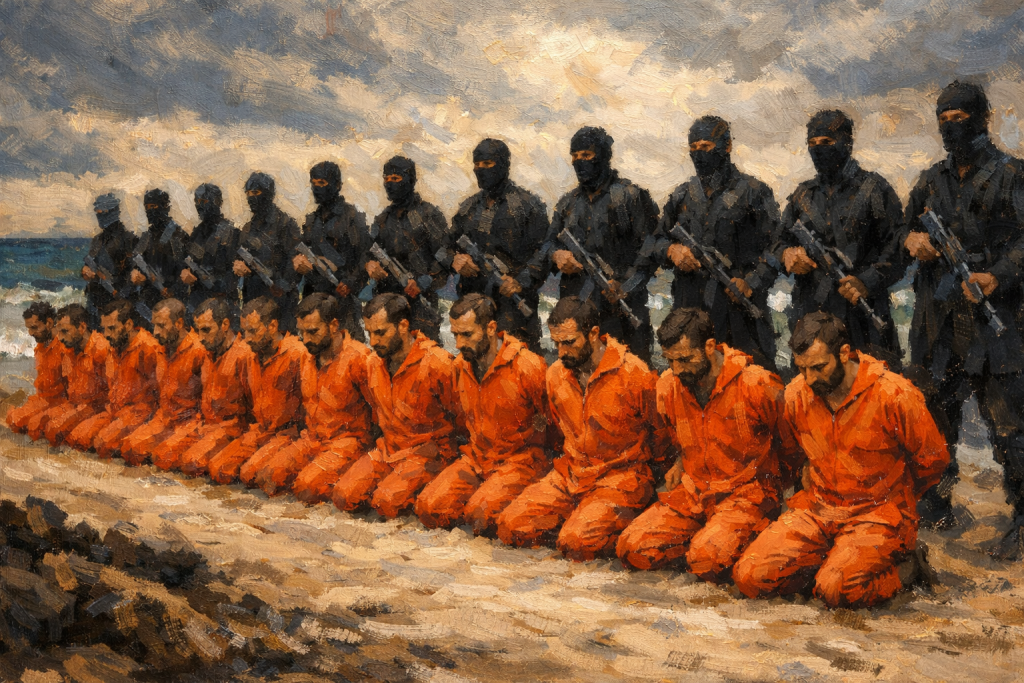
Online insults, workplace mockery, and cultural pressure are no comparison to what believers in other places endure, where parents watch their children executed for the name of Messiah—yet they stand firm, living out what we see in Revelation.
When we compare our cultural discomforts to the suffering of believers in places like Nigeria or Libya, we are humbled by their steadfastness and love for Messiah, even in the face of death.
They defeated him because of the Lamb’s blood and because of the message of their witness. Even when facing death
they did not cling to life. —Revelation 12:11
This stark contrast exposes an uncomfortable truth: the Western church has grown soft, insulated, and unprepared for persecution, despite Yeshua’s words. Again from John:
“I have said these things to you so that, united with me, you may have shalom. In the world, you have tsuris. But be brave! I have conquered the world!” —John 16:33
Perhaps that is why the promise of escape is so appealing here in the West. We would rather be spared than strengthened, even though Scripture calls us to “Accept your share in suffering disgrace as a good soldier of the Messiah Yeshua.” (2 Timothy 2:3).
Walking in Torah means walking the narrow road, even when it’s hard. Even when it costs. Even when the world grows dark and ugly.
Our Messiah never told us to look for a way out. He told us to watch, stand, and remain faithful.
“Don’t be afraid of what you are about to suffer…. Remain faithful, even to the point of death; and I will give you life as your crown.”
— Revelation 2:10
Scripture does not emphasize escape from suffering, but faithfulness through it. From the prophets to the apostles, we see a consistent call to endure, to trust Yahweh even when obedience is costly.
Yeshua Himself told us plainly that following Him would not always be easy, yet He also promised His presence in every trial. The early believers did not ask how to avoid persecution. They asked for boldness to stand (Acts 4:29).
Their lives remind us that our faith is not proven in comfort, but in obedience. As we witness the courage of persecuted believers around the world, may we be stirred—not to fear—but to deeper devotion, gratitude, and readiness to walk faithfully no matter the cost.
Prayerful Reflections
Believing in a pre-tribulation rapture is not a salvation issue. Scripture is clear that we are saved by grace through faith, not by having perfect end-times theology. Many sincere believers hold this view, and they love the Lord deeply.
However, while it does not determine salvation, it can be spiritually dangerous. When we expect to be removed before hardship, we may be unprepared for suffering, persecution, or testing. If trials come and we believed we would be gone before they arrived, fear, confusion, and even shaken faith can follow. Yeshua warned us that difficult days would come, and He urged us to watch, stand firm, and endure.
The danger is not in when we believe Messiah returns, but in what we prepare our hearts and minds for. Scripture repeatedly calls believers to endurance, faithfulness, and courage in the face of tribulation.
Yeshua warned that the Antichrist would be extremely deceptive, so good at it he could deceive the very elect (the believers), and warned us to pay attention and be alert.
If we teach escape instead of perseverance, we risk raising unprepared disciples. And we won’t be alert, watching out for that smooth-talking, miracle-working great deceiver.
The Bible does not promise removal from hardship—it promises God’s presence through it.
So while different views can exist within the body of believers, we must anchor our hearts in readiness, not rescue. Our hope is not in avoiding suffering, but in remaining faithful to the One who walks with us through the refining fire.