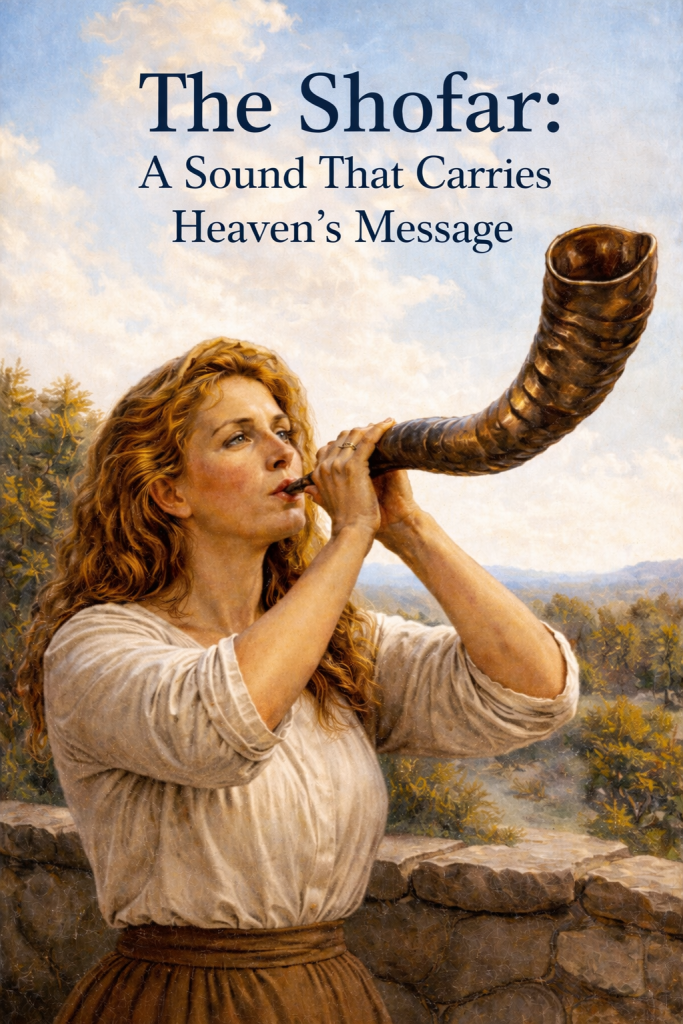
Long before microphones, loudspeakers, or church bells, God chose something simple to carry His voice across valleys and into human hearts — a ram’s horn.
Rough. Curved. Untamed.
The shofar does not produce polished music. It cries out. It pierces the air. It demands attention. And every time it is blown in Scripture, something sacred is happening.
The shofar is not background noise. It is a heavenly announcement.
God Speaks Through the Shofar
Imagine standing at Mount Sinai. The mountain trembles. Smoke rises. Thunder rolls. And then a sound fills the air — not from human lips, but from heaven itself.
“As the sound of the shofar grew louder and louder, Moshe spoke; and God answered him with a voice.”
—Exodus 19:19
The trumpet grew louder, and God answered. The shofar became the bridge between heaven and earth. It announced that the Creator was present and speaking!
David later echoed this truth:
“God goes up to shouts of acclaim, Adonai to a blast on the shofar.”
—Psalm 47:5(6)
When God moves, the shofar announces it. It reminds us that He is not distant. He is active. He is near.
A Call to Wake Up and Return
Throughout Scripture, the shofar is blown when God’s people need to wake up spiritually. Not gently, but urgently.
“Blow the shofar in Tziyon! Proclaim a holy fast, call for a solemn assembly.”
—Joel 2:15
This is not a celebration blast. This is a heart-check moment. God is calling His people to repentance, humility, and prayer.
Isaiah describes this same urgency:
“Shout out loud! Don’t hold back! Raise your voice like a shofar! Proclaim to my people what rebels they are, to the house of Ya‘akov their sins.”
—Isaiah 58:1
The shofar exposes sin — not to shame us, but to call us home. It is the loving but firm voice of a Father crying out, “Come back to Me!”
Sacred Time Marked by Sacred Sound
God did not leave His people guessing about time. He marked His calendar with holy appointments — and He used the shofar to announce them.
“Tell the people of Isra’el, ‘In the seventh month, the first of the month is to be for you a day of complete rest for remembering, a holy convocation announced with blasts on the shofar.”
—Leviticus 23:24
Yom Teruah – the Day or Feast of Trumpets. A day of trumpet blasts. A day to remember. A day to prepare our hearts.
But perhaps the most beautiful sound came every fifty years.
“Then, on the tenth day of the seventh month, on Yom-Kippur, you are to sound a blast on the shofar; you are to sound the shofar all through your land; and you are to consecrate the fiftieth year, proclaiming freedom throughout the land to all its inhabitants. It will be a yovel for you; you will return everyone to the land he owns, and everyone is to return to his family.”
—Leviticus 25:9-10
The shofar declared freedom. Slaves were released. Debts were erased. Land was restored. The oppressed once again breathed freely. This was a picture of redemption — pointing forward to the freedom that our Messiah would bring.
A Battle Cry of Faith
When Israel went to war, they did not rely only on swords. They lifted shofars.
“When you go to war in your land against an adversary who is oppressing you, you are to sound an alarm with the trumpets; then you will be remembered before Adonai your God, and you will be saved from your enemies.”
—Numbers 10:9
The shofar said, “God, we trust You to fight for us.”
Nowhere is this clearer than at Jericho. No battering rams. No siege towers. Just obedience.
“On the seventh day, they got up early, at sunrise, and went around the city in the same way seven times. That was the only day they encircled the city seven times. The seventh time, when the cohanim blew on their shofars, Y’hoshua said to the people, “Shout! because Adonai has given you the city! But the city and everything in it is to be set aside for Adonai and therefore to be destroyed completely; only Rachav the prostitute is to be spared, she and everyone with her in her house, because she hid the messengers we sent. So you, keep clear of everything reserved for destruction. If you bring a curse on yourselves by taking anything set aside to be destroyed, you will bring a curse on the whole camp of Isra’el and cause great distress there. All the silver and gold, and all the brass and iron utensils are to be separated out for Adonai and added to the treasury of Adonai.”
So the people shouted, with the shofars blowing. When the people heard the sound of the shofars, the people let out a great shout; and the wall fell down flat; so that the people went up into the city, each one straight ahead of him; and they captured the city.”
—Joshua 6:15-20
The shofars sounded — and God moved. Victory came not by human strength, but by faith in the One who brings it.
Declaring God’s King
When a king was crowned in Israel, the shofar announced it.
“Tzadok the cohen took the horn of olive oil out of the tent and anointed Shlomo. They sounded the shofar, and all the people shouted, “Long live King Shlomo!”
—1 Kings 1:39
The blast proclaimed authority, rule and leadership. It told the people, “A king reigns among us.”
Yet even these earthly kings pointed forward to a greater one.
“Then Adonai will be king over the whole world.
On that day Adonai will be the only one, and his name will be the only name.”
—Zechariah 14:9
Every shofar blast whispers to us, reminding us of a kingdom to come that will never end.
Calling God’s People Home
The shofar also speaks of restoration to come.
“On that day a great shofar will sound. Those lost in the land of Ashur will come, also those scattered through the land of Egypt; and they will worship Adonai on the holy mountain in Yerushalayim.”
—Isaiah 27:13
Scattered people. Broken families. Lost sheep. The shofar calls them all back. Home to our Father!
A Warning from the Watchman
In ancient cities, a watchman stood on the wall. If danger approached, he blew the trumpet.
“But if the watchman sees the sword coming and does not blow the shofar, so that the people are not warned; and then the sword comes and takes any one of them, that one is indeed taken away in his guilt, but I will hold the watchman responsible for his death.’”
—Ezekiel 33:6
To remain silent with the coming of danger was sin. The shofar reminds us that the truth must be spoken — even when it is uncomfortable.
The Shofar Foreshadows Messiah’s Return
And finally… the greatest blast of all!
Scripture tells us that our Messiah will not return quietly.
“For the Lord himself will come down from heaven with a rousing cry, with a call from one of the ruling angels, and with God’s shofar; those who died united with the Messiah will be the first to rise”
—1 Thessalonians 4:16
“It will take but a moment, the blink of an eye, at the final shofar. For the shofar will sound, and the dead will be raised to live forever, and we too will be changed.”
—1 Corinthians 15:52
Just as Sinai shook at God’s presence, the earth will shake when Messiah returns. The same sound that once announced God’s glory on a mountain will announce His Son in the sky.
“The seventh angel sounded his shofar; and there were loud voices in heaven, saying, “The kingdom of the world has become the Kingdom of our Lord and his Messiah, and he will rule forever and ever!”
—Revelation 11:15
The shofar is prophetic. It points forward to resurrection. To restoration. To the return of our King.
Prayerful Reflections
The shofar is not just an ancient instrument. It is God’s megaphone through history. It calls us to:
• Listen
• Repent
• Remember
• Trust
• Prepare
“How happy are the people who know the joyful shout!
They walk in the light of your presence, Adonai.”
—Psalm 89:15(16)
My sisters, may we be women who recognize His voice — and respond when He calls.