Every generation seems to search for a tangible way to remember God in the midst of ordinary life. In the 1990s and early 2000s, many Christians wore bracelets stamped with four familiar letters: WWJD—“What Would Jesus Do?” You saw this on keychains, bumper stickers, t-shirts, the list goes on. You still see this from time to time, though not as much.
The idea was simple and sincere. When faced with a decision, the bracelet was meant to prompt reflection, and this was to help the wearer make a decision that was a good example of their Messiah. “What would Jesus say to this person? What would Jesus do in this situation?”
Long before silicone bracelets or printed slogans, Scripture already gave God’s people something remarkably similar: tzitzit.
What Are Tzitzit?
Tzitzit (tzitziyot) are tassels or “fringes” worn on the corners of garments, commanded directly by God. The instruction is found in Numbers 15:37–41, where the LORD tells Moses to instruct the children of Israel to make tassels on the corners of their garments throughout their generations, including a cord of blue.
Shortly after giving His Torah—His Instructions or Law — to His people, someone blatantly broke the Sabbath. The people caught him, took him to Moses and asked Moses what to do. Moses asked God, and God said…kill him.
“While the people of Isra’el were in the desert, they found a man gathering wood on Shabbat. Those who found him gathering wood brought him to Moshe, Aharon and the whole congregation. They kept him in custody, because it had not yet been decided what to do to him. Then Adonai said to Moshe, “This man must be put to death; the entire community is to stone him to death outside the camp.” So the whole community brought him outside the camp and threw stones at him until he died, as Adonai had ordered Moshe.” — Numbers 15:32-36
Then God told the people to make tzitzit as a physical and visual reminder to keep His commandments.
Adonai said to Moshe, “Speak to the people of Isra’el, instructing them to make, through all their generations, tzitziyot on the corners of their garments, and to put with the tzitzit on each corner a blue thread. It is to be a tzitzit for you to look at and thereby remember all of Adonai’s mitzvot and obey them, so that you won’t go around wherever your own heart and eyes lead you to prostitute yourselves; but it will help you remember and obey all my mitzvot and be holy for your God. I am Adonai your God, who brought you out of the land of Egypt in order to be your God. I am Adonai your God.” — Numbers 15:37-41
God Himself explains their purpose: They would see the tzitizit and remember to walk in the ways of God. (Numbers 15:39). Tzitzit were designed to be seen, to be part of daily life, and to redirect the heart toward obedience.
They are not mystical objects, or “lucky charms” — but memory tools—visible reminders that God’s ways, not human are to be followed.
This theme of remembrance runs throughout Scripture. Deuteronomy calls God’s people to keep His words constantly before them—spoken, taught, bound, and written into daily life (Deuteronomy 6:4–9). Tzitzit fit seamlessly into that pattern: faith woven into movement, obedience stitched into the ordinary.
Tzitzit in the New Testament
What is often overlooked in Christian teaching is that tzitzit appear in the New Testament as well. In fact, they appear most powerfully in the life and ministry of Yeshua (Jesus) Himself.
The Gospels describe people reaching for the “hem” or “fringe” of Yeshua’s garment. In Matthew 9:20 and Luke 8:44, a woman suffering from a twelve-year issue of blood presses through the crowd and touches the hem of His garment, believing she would be healed.
“As he went, with the crowds on every side virtually choking him, a woman who had had a hemorrhage for twelve years, and could not be healed by anyone, came up behind him and touched the tzitzit on his robe; instantly her hemorrhaging stopped. Yeshua asked, “Who touched me?” When they all denied doing it, Kefa said, “Rabbi! The crowds are hemming you in and jostling you!” But Yeshua said, “Someone did touch me, because I felt power go out of me.” Seeing she could not escape notice, the woman, quaking with fear, threw herself down before him and confessed in front of everyone why she had touched him and how she had been instantly healed. He said to her, “My daughter, your trust has saved you; go in peace.”” —Luke 8:42-48
The Greek word used in these passages is kraspedon, the same word used in the Septuagint (the Greek translation of the Hebrew Scriptures) for the tassels commanded in Numbers 15.
This detail matters. The woman was not touching a random edge of fabric. She was grasping the tzitzit—the very symbol of God’s commandments. Her act was not superstition; it was faith grounded in Scripture. She reached out to the visible reminder of covenant faithfulness worn by the Messiah Himself.
Later, Matthew records that crowds begged just to touch the fringe of Yeshua’s garment as well.
“Having made the crossing, they landed at Ginosar. When the people of the place recognized him, they sent word throughout the neighborhood and brought him everyone who was ill. They begged him that the sick people might only touch the tzitzit on his robe, and all who touched it were completely healed.”—Matthew 14:34-36
Again, this is not incidental language. The Gospel writers assume their readers understand what those fringes represent. Yeshua wore tzitzit because He lived in perfect obedience to the Torah. He did not abolish God’s commandments; He embodied them.
Who Are Tzitzit For?
Although tzitzit are often associated today with Jewish men, Scripture does not restrict the command by gender or age. The instruction is given to the children of Israel as a whole and applies “throughout their generations” (Numbers 15:38). In the biblical world, garments were not divided by modern categories, and God consistently addressed His covenant people collectively.
This becomes especially significant for Torah-observant Christians. The New Testament teaches that Gentile believers are not a separate spiritual people with a different standard of holiness. Through Messiah, we have been grafted into Israel and made fellow citizens of the covenant promises (Romans 11:17–24; Ephesians 2:11–19).
Wearing tzitzit is not about becoming Jewish or adopting ethnic identity. It is about walking in covenant faithfulness to the same God whose commandments Yeshua upheld and taught.
What Tzitzit Do (and What They Don’t)
Tzitzit were never meant to be displays of spiritual status. Yeshua strongly rebuked religious leaders who wore them for attention, enlarging their tassels to appear more righteous than others.
“Everything they do is done to be seen by others; for they make their t’fillin broad and their tzitziyot long” —Matthew 23:5
The problem was not obedience—it was pride. “Look how holy we are!”
Properly understood, tzitzit are to humble us. They exist to counter our fleshly tendency to drift toward doing what we want. Numbers 15 explicitly connects tzitzit with resisting the pull of the heart and eyes—language that carries forward into the New Testament’s warnings about deception, lust, and selfish desires. (James 1:14–15; 1 John 2:16).
Tzitzit quietly ask us: Am I walking according to God’s instruction, or according to myself?
Tzitzit and the WWJD Movement
This is where the comparison to WWJD becomes comes full circle.
The WWJD movement encouraged believers to pause and consider Messiah’s example before acting. That instinct is good and deeply biblical. Yeshua said plainly, “If you love Me, keep My commandments” (John 14:15), and “Whoever practices and teaches these commandments will be called great in the kingdom of heaven” (Matthew 5:19).
The challenge has always been defining what those commandments are.
Tzitzit answer that question clearly. Rather than relying on internal feelings or imagined scenarios, tzitzit point outward to God’s revealed instruction. They remind the wearer not just to think about obedience, but to remember what obedience actually looks like according to Scripture.
In that sense, tzitzit are the original WWJD—only firmer, more concrete, and weren’t our idea…it was God’s. They do not ask us to guess what faithfulness means. They remind us of what God has already said.
A Living Reminder of Love and Loyalty
For Torah-observant Christians, tzitzit can be a meaningful response to grace, not a requirement for salvation. They are a visible way of saying, “I belong to the God who redeemed me, and I want His ways before my eyes.”
In a world filled with slogans and spiritual shortcuts, tzitzit remain what they have always been: a steady, faithful witness that love for God is not merely spoken—it is remembered, practiced, and walked out in our daily lives.
How to Make Tzitzit
When we look closely at Scripture itself, the instructions for making tzitzit are surprisingly simple. Numbers 15:37–41 gives the entirety of God’s command. Let’s look at that again.
Adonai said to Moshe, “Speak to the people of Isra’el, instructing them to make, through all their generations, tzitziyot on the corners of their garments, and to put with the tzitzit on each corner a blue thread. It is to be a tzitzit for you to look at and thereby remember all of Adonai’s mitzvot and obey them, so that you won’t go around wherever your own heart and eyes lead you to prostitute yourselves; but it will help you remember and obey all my mitzvot and be holy for your God. I am Adonai your God, who brought you out of the land of Egypt in order to be your God. I am Adonai your God.” — Numbers 15:37-41
- The children of Israel are to make tassels on the corners of their garments
- Throughout their generations
- Include a cord of blue among the threads.
The purpose is to remind us—so that when the tassels are seen, the wearer remembers all the commandments of the LORD and does them, rather than following the impulses of the heart and eyes.
- No measurements are given.
- No knot patterns are described.
- No specific material, number of windings, or tying method is prescribed.
Scripture tells us why tzitzit are worn far more clearly than it tells us how they must look.
Deuteronomy reinforces the same idea when it instructs God’s people to make tassels on the four corners of the garment with which they cover themselves.
“You are to make for yourself twisted cords on the four corners of the garment you wrap around yourself.” —Deuteronomy 22:12
Again, the command is brief and functional. The focus remains on obedience and remembrance, not craftsmanship or uniformity.
Biblically speaking, tzitzit are defined by three elements only:
- they are attached to the corners of a garment
- they are visible
- and they serve as a reminder of God’s commandments
Rabbinic tradition, however, goes much further. Over centuries, detailed systems developed that specify the exact number of knots, windings, strings, and even symbolic numerology associated with tzitzit. There are variation depending upon what line the family is as well. Ashkenazi tie tzitzit using a pattern of five double knots with windings grouped in 7–8–11–13, totaling 39 windings, representing “The LORD is One.” Sephardi also use five knots, but often with different winding groupings, such as 10–5–6–5, to represent the tetragrammaton of God’s name – YHVH. There are traditions for Yemenites, Italki, Hasidic and on. But these are traditions, not commandments.
Traditional Jewish practice often also requires a specific undergarment (such as a tallit katan), precise tying sequences, and, in many communities, avoids the blue thread altogether due to debates over its historical source. These traditions are meaningful within Judaism and are intended to safeguard obedience, but they are not found in the Scriptures.
For Torah-observant Christians, this distinction matters. Scripture never commands adherence to rabbinic interpretation as binding authority. Yeshua Himself consistently affirmed the Torah while challenging traditions that elevated human rules to the level of divine command (Mark 7:6–13). We should fee free to obey the command as it is written without feeling bound to later traditions that go beyond what God required.
Biblically, tzitzit are not about perfect knots or prescribed patterns. They are about faithful remembrance. When we honor what Scripture actually says—without adding requirements God did not give—we preserve the heart of the command: a visible, daily reminder to walk in obedience out of love for the One who redeemed us.
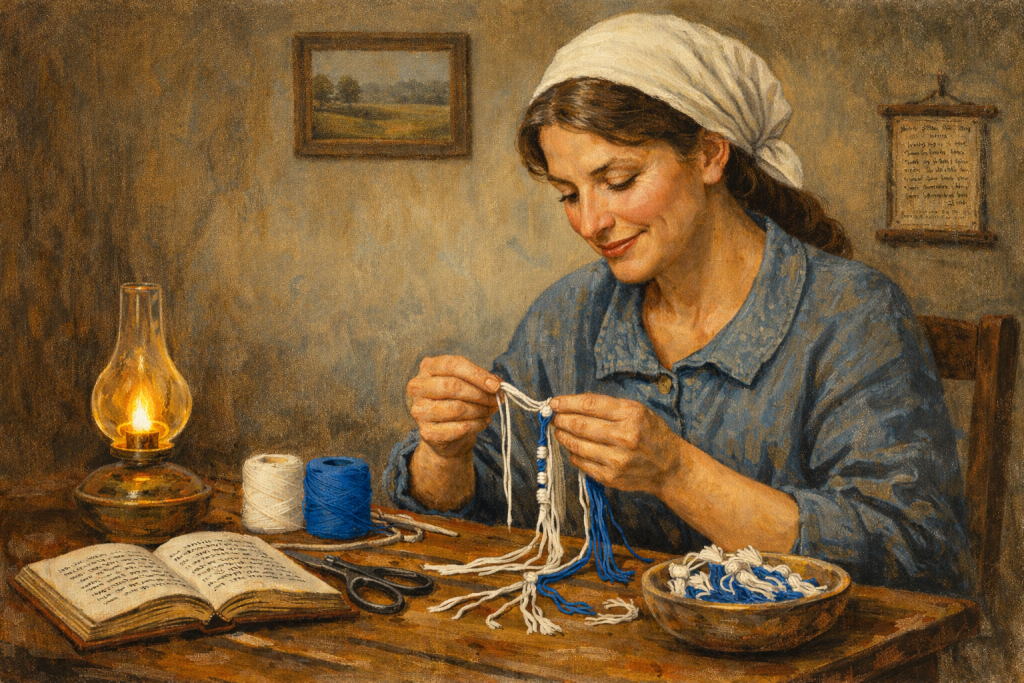
Making tzitzit with your children is a great craft project. You can braid them, macrame, or make them simple loose tassels.
Tzitzit can be any design or color, as long as there’s a single thread of blue, and there are 4 of them. While you make them with your children, teach them about following God’s instructions and how these little decorations help us to remember.
When wearing your tzitzit, some people will wear two in front and two in back, clipped or pinned to pockets, waistbands or belt loops.
Some choose to wear two on each side, since most of our modern clothing doesn’t have 4 corners, and the side seams is where the “corners” come together.
Again, the command is very limited. Beyond that, have fun with it!
I will share a few ways that I make and wear tzitzit in a future article.