The Counting of the Omer is the biblical command of counting the days between Firstfruits and Shavuot.
It is also known as the Feast of Weeks or the Greek name Pentecost.
It is a daily counting of seven full weeks: forty-nine days, with Shavuot observed on the fiftieth day.
There’s really not a lot of in formation about this appointed time, other than we are supposed to mark the passing of time.
“‘From the day after the day of rest — that is, from the day you bring the sheaf for waving — you are to count seven full weeks, until the day after the seventh week; you are to count fifty days; and then you are to present a new grain offering to Adonai.
—Leviticus 23:15–16
The word omer refers to a measure of grain, and in this context it is connected to the wave offering of firstfruits brought before God. The counting begins with the offering of the first of the harvest and leads to the later harvest celebration of Shavuot.
A Season of Expectation
The Counting of the Omer is more than just marking time. It is a journey from redemption to revelation.
Israel was delivered from Egypt at Passover, but then they journeyed toward knowing God more deeply and receiving His instruction.
In the same way, the Omer reminds us that redemption is not the end of the story. We are redeemed so that we may walk with Him in holiness and obedience.
The Father told His people to keep His appointed times throughout their generations.
“Adonai said to Moshe, “Tell the people of Isra’el: ‘The designated times of Adonai which you are to proclaim as holy convocations are my designated times. “‘Work is to be done on six days; but the seventh day is a Shabbat of complete rest, a holy convocation; you are not to do any kind of work; it is a Shabbat for Adonai, even in your homes. “‘These are the designated times of Adonai, the holy convocations you are to proclaim at their designated times….On the same day, you are to call a holy convocation; do not do any kind of ordinary work; this is a permanent regulation through all your generations, no matter where you live.”
—Leviticus 23:1-4, 21
The counting itself teaches us to be intentional, and expectant. Each day becomes an opportunity to examine our hearts, give thanks, and remember that our lives are meant to be ordered around His times and His ways.
Yeshua and the Omer
In the book of Acts, we see where Yeshua was crucified at Passover, just as the lambs were being slaughtered. He was resurrected at First Fruits.
“But the fact is that the Messiah has been raised from the dead, the firstfruits of those who have died. For since death came through a man, also the resurrection of the dead has come through a man. For just as in connection with Adam all die, so in connection with the Messiah all will be made alive. But each in his own order: the Messiah is the firstfruits; then those who belong to the Messiah, at the time of his coming”
—1 Corinthians 15:20–23
Then He stayed here on earth, teaching the disciples for 40 days.
“After his death he showed himself to them and gave many convincing proofs that he was alive. During a period of forty days they saw him, and he spoke with them about the Kingdom of God.”
—Acts 1:3
Ten days after His ascension was Shavuot. And we know from scripture that this was another appointed time, that the Father used to mark another momentous event.
“The festival of Shavu‘ot arrived, and the believers all gathered together in one place. Suddenly there came a sound from the sky like the roar of a violent wind, and it filled the whole house where they were sitting. Then they saw what looked like tongues of fire, which separated and came to rest on each one of them. They were all filled with the Ruach HaKodesh and began to talk in different languages, as the Spirit enabled them to speak.”
—Acts 2:1-4
What Does It Teach Believers Today?
For believers, the Counting of the Omer connects us to the biblical calendar and helps us meditate on the faithfulness of God between Passover and Shavuot.
It is a time to remember that God frees His people from bondage.
“When your children ask you, ‘What do you mean by this ceremony?’ say, ‘It is the sacrifice of Adonai’s Pesach [Passover], because [Adonai] passed over the houses of the people of Isra’el in Egypt, when he killed the Egyptians but spared our houses.’” The people of Isra’el bowed their heads and worshipped.”
“He summoned Moshe and Aharon by night and said, “Up and leave my people, both you and the people of Isra’el; and go, serve Adonai as you said. Take both your flocks and your herds, as you said; and get out of here! But bless me, too.” The Egyptians pressed to send the people out of the land quickly, because they said, “Otherwise we’ll all be dead!”
The people took their dough before it had become leavened and wrapped their kneading bowls in their clothes on their shoulders. The people of Isra’el had done what Moshe had said — they had asked the Egyptians to give them silver and gold jewelry and clothing; and Adonai had made the Egyptians so favorably disposed toward the people that they had let them have whatever they requested. Thus they plundered the Egyptians.
The people of Isra’el traveled from Ra‘amses to Sukkot, some six hundred thousand men on foot, not counting children. A mixed crowd also went up with them, as well as livestock in large numbers, both flocks and herds. They baked matzah loaves from the dough they had brought out of Egypt, since it was unleavened; because they had been driven out of Egypt without time to prepare supplies for themselves.
The time the people of Isra’el lived in Egypt was 430 years. At the end of 430 years to the day, all the divisions of Adonai left the land of Egypt. This was a night when Adonai kept vigil to bring them out of the land of Egypt, and this same night continues to be a night when Adonai keeps vigil for all the people of Isra’el through all their generations.”
—Exodus 12:26-27, 31–42
God calls His people to walk in His ways.
“‘You have seen what I did to the Egyptians, and how I carried you on eagles’ wings and brought you to myself. Now if you will pay careful attention to what I say and keep my covenant, then you will be my own treasure from among all the peoples, for all the earth is mine; and you will be a kingdom of cohanim for me, a nation set apart.’ These are the words you are to speak to the people of Isra’el.”
—Exodus 19:4–6
God desires a holy people set apart for Him.
“Rather, you people are to be holy for me; because I, Adonai, am holy; and I have set you apart from the other peoples, so that you can belong to me.”
—Leviticus 20:26
This time of counting becomes a reminder of both God’s provision and His continuing work in us.
How Can We Honor Counting the Omer?
The only command is to count the weeks and days from First Fruits for 7 weeks, then the next day is Shavuot.
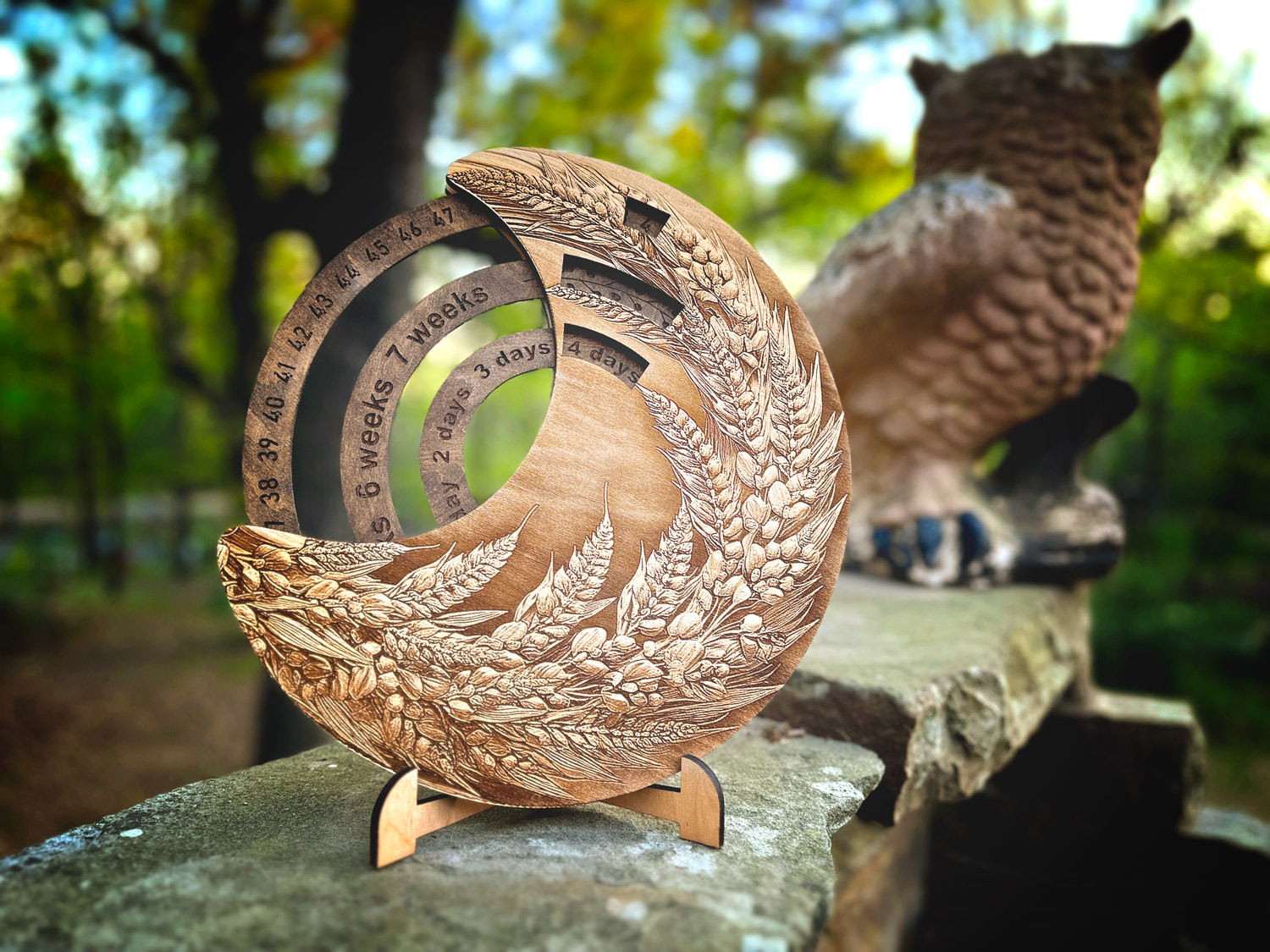
What this looks like can vary greatly. Some will simply mark the days off on a calendar. Some I know take a bowl of pretty stones, and each day they will put a stone in a vase, marking each day passing.
I have a wood counting decoration that I ordered from Etsy some time ago, as you can see in the image at the top of the page.
You can actually find several different ones on that website.
But however you like to mark the passing of time, remember this is a holy time, appointed by the Father.
A Daily Invitation
The Counting of the Omer is a daily reminder to number our days before the Lord. It teaches us to watch, prepare, and draw near to Him one day at a time.
Rather than rushing from one feast to the next, we are given a special path to walk day by day and week by week, and that His promises will be kept in due time.