When followers of Yeshua (Jesus) first begin learning about the biblical feast days, Yom Kippur can feel a little daunting.
Passover is easy to connect with Yeshua.
The Feast of Unleavened Bread points us toward removing sin from our lives.
Shavuot brings to mind the giving of the Torah and the pouring out of the Holy Spirit.
The Feast of Trumpets is filled with the sounds of the shofar and anticipation of the coming King.
But Yom Kippur is different because it is solemn.
It is a day of humbling ourselves before God, examining our lives, repenting of sin, and remembering just how desperately we need the atonement that only the blood of the Lamb can provide.
We do not observe this day wondering whether God has provided a way for us to be reconciled to Him.
We know that He has.
His name is Yeshua.
What Is Yom Kippur?
Yom Kippur is commonly called the Day of Atonement.
It is one of the appointed times or moedim, that God established in the bible. We first see the instructions for the day in Leviticus 16, and it is included among His appointed times in Leviticus 23.
God told Israel:
“The tenth day of this seventh month is Yom-Kippur; you are to have a holy convocation, you are to deny yourselves, and you are to bring an offering made by fire to ADONAI.”
— Leviticus 23:27
The day falls on the tenth day of the seventh biblical month and it is ten days after Yom Teruah, the Feast of Trumpets.
God describes Yom Kippur as a Sabbath of rest and humility:
“It will be for you a Shabbat of complete rest, and you are to deny yourselves; you are to rest on your Shabbat from evening the ninth day of the month until the following evening.”
— Leviticus 23:32
Yom Kippur is not one of the joyful pilgrimage festivals with feasting and celebration. It is a day set apart for humility, repentance, reflection, and atonement.
What Happened on the Day of Atonement?
Leviticus 16 gives us the instructions of Yom Kippur under the Levitical priesthood.
One time every year on the appointed day, the High Priest would bring an offering for the sins of himself and for the entire nation of Israel.
There was a ram and bull that were slaughtered as a burnt offering for his own sin and the sins of his family. He had to be purified before he could offer the sacrifice for the people.
The blood of his own sacrifice was taken into the Holy of Holies, to the very presence of God and the ark of His covenant. If the priest hadn’t first made offerings to purify himself, he would die in the presence of God.
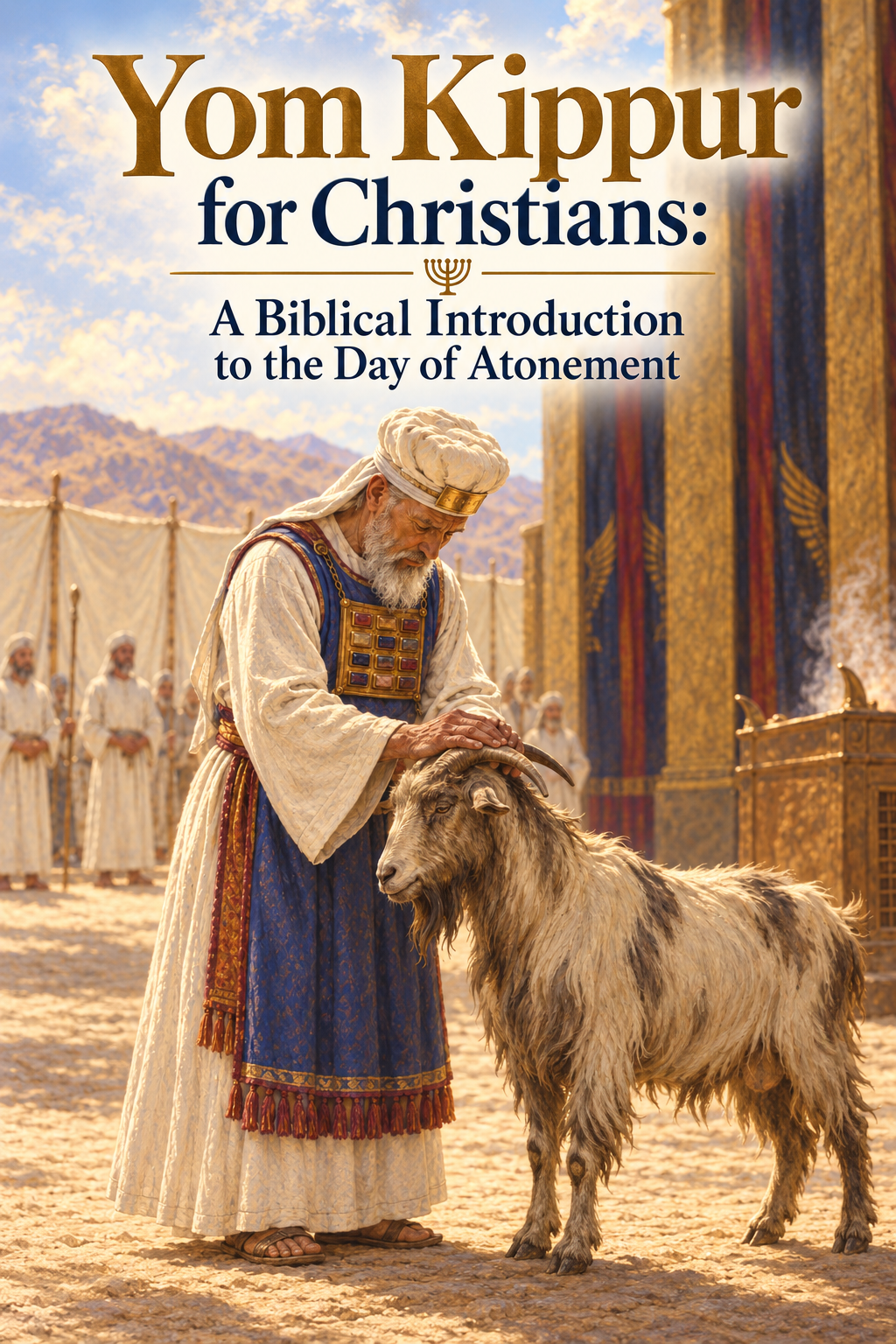
Two male goats were selected. Lots were cast and one was assigned for sacrifice. The other goat would have the hands of the priest laid upon its head as the priest confessed the sins of the nation. Then the goat was sent to carry off the sins of the people into the wilderness, never to return.
The picture painted here is very powerful.
Sin brings death, separates us from a holy God, and it must be paid for with blood. And yet God Himself provided a way for His people to be cleansed and restored.
Yom Kippur taught Israel (and still teaches us) that we cannot simply dismiss sin. Sin brings death, but there is also mercy.
Yom Kippur and Yeshua
For followers of Yeshua, the Day of Atonement becomes even more meaningful when we read the book of Hebrews.
The earthly tabernacle, priesthood, and sacrificial system pointed toward something greater.
Hebrews explains that Yeshua serves as our High Priest, but that unlike the Levitical High Priest, who entered the earthly sanctuary yearly and repeatedly with the blood of animals, Yeshua accomplished something far greater once and for all.
“But when the Messiah appeared as cohen gadol of the good things that are happening already, then, through the greater and more perfect Tent which is not man-made (that is, it is not of this created world), he entered the Holiest Place once and for all. And he entered not by means of the blood of goats and calves, but by means of his own blood, thus setting people free forever.”
— Hebrews 9:11-12
Yeshua’s sacrifice did what the blood of bulls and goats never could.
“For it is impossible that the blood of bulls and goats should take away sins.”
— Hebrews 10:4
When we observe Yom Kippur today, we are not attempting to earn forgiveness through our observance. We are acknowledging the seriousness of our sin and we are thanking God for the perfect High Priest and perfect sacrifice He has provided.
We are remembering the tremendous cost of our redemption. Not just the blood of a lamb, goat or bull. It was the blood of The Lamb.
But If Yeshua Atoned for Our Sins, Why Observe Yom Kippur?
This is usually one of the first questions Christians will ask. If Yeshua has already made atonement for us, why would we observe a Day of Atonement?
Because remembering God’s work does not diminish it, rather it honors it and also teaches the next generation of the goodness and mercy of our God.
We celebrate Passover even though Yeshua, our Passover Lamb, has already been sacrificed.
We remember His resurrection even though it happened nearly two thousand years ago.
Yom Kippur gives us a yearly opportunity to stop everything else and consider some very important questions.
Have we allowed sin to creep back into our lives? Are we harboring bitterness or unforgiveness towards another? Remember we have to forgive if we want forgiveness.
Have we become casual or ungrateful for the sacrifice Yeshua made for us?
Yom Kippur is not about trying to become saved all over again. But it is about taking sin seriously because we belong to the One who redeemed us from it.
Isn’t Yom Kippur Only for Jewish People?
As discussed in the article about Yom Teruah, the appointed times belong to God Himself. He established them and called them His.
Of course, these holy days were entrusted to Israel, and the Jewish people have preserved knowledge of them for generations. But followers of Yeshua from the nations have been grafted into the family tree. (Romans 11.)
We look to Yom Kippur as a time of remembrance, reflection and gratitude.
So how do we keep it today?
If you are new to Yom Kippur, you don’t need an elaborate ceremony or to recreate temple rituals.
You do not need special clothing, a complicated script, or a long list of man-made rules.
Start with Scripture, and what it says.
- Keep this as a holy Shabbat – a day of rest, no regular work (sunset to sunset)
- Have a holy convocation – time with the Father and other believers, if you can. Many people watch services online if they have no others in their community who keep the Moedim.
- Remember the atonement that was made for us
- Pray for our nation, confessing the sins and asking forgiveness from God and others.
- Afflicting ourselves
Treat It as a Sabbath
God calls Yom Kippur a Sabbath of complete rest. That means ordinary work is set aside.
Prepare beforehand so that you can devote the day to God rather than your normal responsibilities. The same as you would “Prep day” for the weekly Sabbath.
Put away the distractions and give the Father your attention.
What does it mean to “Afflict?”
The word “afflict” is “ānâ” (aw-naw.)
In many bibles, it is translated as “fast.” But that is not the same word. The word “fast” – to abstain from food, is “ṣûm.”
This word of afflict – ānâ, means “to become low, give heed, to pay attention, to give account.” And looking at the root of the word, it means “to look down, to bow, to be humble.”
To afflict means to give an account, remember, and to humble ourselves before YHVH. It is a day of somber reflection, and thankfulness for the atoning sacrifice that was made by our High Priest, Yeshua.
If you are physically able, you may choose to fast from food for the day. But it should not be viewed as an attempt to prove spiritual devotion. The point is not simply an empty stomach, it is a humbled heart.
Isaiah 58 gives a powerful warning about fasting without repentance. God was not impressed by people abstaining from food while continuing in injustice, selfishness, and sin.
True fasting should turn our hearts toward God.
Spend Time in Repentance
Yom Kippur is a wonderful time to ask God to search your heart.
David prayed:
“Examine me, God, and know my heart; test me, and know my thoughts. See if there is in me any hurtful way, and lead me along the eternal way.”
— Psalm 139:23-24
Sit quietly before God and ask Him to reveal areas of disobedience, pride, bitterness, selfishness, or compromise in your life. And when He brings something to mind, repent.
Remember Biblical repentance is more than feeling guilty.
It means doing a 180° turn from where you were going (towards sin) and returning to God’s ways.
Make Things Right If You Can
Our relationship with God cannot be separated from how we treat other people. Yeshua taught that if we realize someone has something against us, reconciliation should matter to us.
Yom Kippur is a good time to consider whether there is someone you need to apologize to. You can’t force another person to forgive you or restore a relationship. But you can make sure that, as far as it depends upon you, you are walking uprightly.
Read About Atonement
You may want to spend part of the day reading scriptures that explain Yom Kippur and point toward the work of Yeshua.
Here are a few scriptures to consider:
- Leviticus 16
- Leviticus 23:26-32
- Numbers 29:7-11
- Psalm 32
- Psalm 51
- Psalm 103
- Isaiah 53
- Isaiah 58
- Romans 3:21-26
- Hebrews 4:14-16
- Hebrews 7-10
- 1 John 1:5-2:2
Don’t rush through them. Allow yourself time to think about what atonement means, while considering the holiness of the Father.
Then be reminded about the mercy and desperate need we all had for the atoning sacrifice of our Messiah Yeshua.
Is Yom Kippur Supposed to Be Sad?
Yom Kippur is solemn and serious. There may be tears, conviction and hard moments of confession. But for those who belong to Yeshua, repentance does not end in despair, it ends in gratefulness and mercy.
We come before God acknowledging that we have sinned, but we do not come wondering whether there is any hope for us.
We know our High Priest who who carried our sin.
Yom Kippur brings us face to face with the ugliness of sin, but it also brings us face to face with the extraordinary love of God.
That should leave us deeply humbled and and forever grateful.
Yom Kippur Also Points Forward
There is another side of Yom Kippur that we shouldn’t forget. The biblical appointed times are not merely memorials of the past, they also teach us to look forward.
The bible repeatedly speaks about a future day when Israel will recognize the One whom they pierced.
Zechariah tells us:
“I will pour out on the house of David and on those living in Yerushalayim a spirit of grace and prayer; and they will look to me, whom they pierced…”
— Zechariah 12:10
The next chapter speaks about a fountain being opened for cleansing from sin and impurity. The prophetic picture is unmistakable.
Many believers see Yom Kippur as a prophetic picture of national repentance, judgment, cleansing, and restoration connected with the return of Messiah.
Whether we understand every prophetic detail perfectly or not, the message is clear: A day is coming when every human being will have kneel before the holiness of God and give an account of what they have done.
Has the blood of the sin sacrifice been applied…or not?
Prayerful Reflections
If you are just beginning to learn about the biblical feast days, don’t allow yourself to become overwhelmed by all the traditions and opinions you may encounter out there about it. As always simply go back to the bible and what it commands.
It is about repentance, mercy and most of all, it is about the incredible provision God has made for His people through Yeshua our Messiah, our sacrifice, and our eternal High Priest.
For those of us who follow Him, Yom Kippur is a beautiful opportunity to remember that we were guilty.
But the Father provided the atonement. And because of Yeshua, we can draw near.
A Prayer for Yom Kippur
Father,
You are holy, righteous, merciful, and good. Search my heart and show me anything that is not pleasing to You. Forgive me for the times I have disobeyed Your instructions, ignored Your conviction, or treated sin lightly.
Help me to not simply feel sorry about my sin, but truly to turn away from it.
Give me the humility to make things right where I have wronged others and the grace to forgive those who have wronged me.
Thank You for providing the atonement I could never provide for myself.
Thank You for Yeshua, my Messiah and High Priest.
Thank You that through Him I can come boldly before Your throne of grace to receive mercy and find help when I need it.
Teach me to walk in obedience, humility, gratitude, and love.
May this appointed time draw me closer to You and deepen my understanding of the incredible gift You have given us through Yeshua.
In Yeshua’s name, Amen.
To learn more about Yom Kippur, check out this article over on Cosmopolitan Cornbread.